Core Business Innovations
Business & Technology Initiative Map
How core platform capabilities assemble into an integrated commercialisation pipeline – moving from initial regulatory sandbox validation to full multi-tenant cohort deployment.
Discovery Sprints
Rapid positioning workshops for executive leaders to map ecosystem capabilities directly to business goals.
Pace-layered talent pipeline and co-creation labs to upskill domain specialists on Constitutional OS runtimes.
Commercial delivery engine translating validated prototypes into production-grade BIAN-aligned PBC services.
Composable PBC marketplace enabling tenants to plug and play governed identity, payment, and audit primitives.
The Boardroom Dilemma: The collapse of single-tenant branch estates, expanding physical service deserts, and predatory 2–3% card interchange tolls demand structural transformation. The Salient Innovation Set replaces single-tenant CapEx traps with pooled, sovereign infrastructure.
Phygital Service Arbitrage
A new model for monetising digital services at physical points of interaction. Under eIDAS 2.0 / QTSP credentials and DORA compliance-by-construction, tenants pay GaaS / Micro-royalties per interaction. Micro-royalties and Assurance Premiums are metered dynamically on the Lawful Act Hyperedge (LAHE), using Programmatic JIT Funding and ephemeral OBO Tokens to eliminate intraday settlement risk, with clearing executing account-to-account (A2A) via SEPA Instant / ISO 20022 to bypass traditional card schemes.
Pooled Infrastructure Model
Moving organisations to shared, pooled resource models. Multi-tenant edge co-location relies on hardware-isolated, memory-encrypted TEE Hardware-Isolated Enclaves and Threshold Cryptography (MPC) to prevent physical key exposure at the edge, offering absolute tenant isolation with 60 – 80% cost reduction. Costs are amortised through Complexity-Based Pricing (scaling with the Cyclomatic Complexity of the Agreement DAG) and Submission Tokens (GaaS) acting as "Submission Gas". By moving operational risk from probabilistic to prevented via the DRAGON Adjudication Substrate, FSIs achieve Basel IV Capital Relief through reduced Pillar 2 capital add-ons.
Agentic Economy Enablement
Enables autonomous AI agents to act as governed economic actors. By sandwiching neural models within a deterministic Neuro-Symbolic Sandwich, agent actions are strictly bounded within a symbolic Action Space. AI agents act under time-bound, intent-scoped On-Behalf-Of (OBO) Tokens to confine their kinetic execution rights, with any non-compliant behaviour triggering an immediate kernel-level Structural VETO.
Digital Public Infrastructure
Universal and ubiquitous infrastructure that bridges the digital divide. Operating in offline Autonomous Edge Resilience via a cached Legal-State Reachability Graph (LSRG), the edge remains fully functional for pre-authorised civic tasks and sub-threshold payments. Personal customer data is removed via PAIF Cryptographic Shredding of the PII decryption keys, satisfying the "Right to Erasure" (GDPR), while the anonymous compliance hashes remain in the immutable LAHE to satisfy retention mandates (AMLR).
Seven Foundational Platform Innovations
Distilled from the platform corpus in strict order of foundational necessity – from the root invention of agreement-based authority to insurable autonomy and zero-CAPEX pooled economics.
Authority Lives in the Agreement, Not in Identity
Every legacy system treats “who you are” as the bearer of permission. The Constitutional OS treats the agreement as the sole source of authority: a role must be granted, an agreement must authorise that role, the agreement itself decides the case, and an immutable audit record proves it occurred. Remove any single component and you are back to trusting human behaviour.
Unlawful Execution is Unavailable (Insurability by Construction)
Unlawful execution is a state the platform physically cannot enter. Not detected late, not remediated, not fined – unavailable. The commercial term for this is not merely “compliant”, it is insurable. Underwriters can price a system that structurally cannot violate a rule; they cannot price one that promises not to.
Constitutional Delegation & Agentic Liability
The answer to “who do I sue when the agent does it?” Every delegation token binds the specific humans accountable for that agent at build time, expires after a single action (not a session), and is valid only once the gatekeeper has adjudicated the act. Provides the industry’s first defensible liability frame for agentic commerce.
Lawful Execution at the Counter (Offline Edge Resilience)
Adjudicating before physical execution directly on the POI appliance – even during a network partition or power outage. Combines business continuity with public-interest civic resilience across diverse regional jurisdictions and sovereign corridors.
Many Tenants, One Appliance (Pooled Economics)
The economics that make edge deployment scalable. A bank, a merchant, and a local council co-exist on the same physical POI appliance with TEE hardware-isolated enclaves and zero cross-visibility.
Flat Target Clearing Fee Over Direct Bank Transfer Rails
A flat €0.10 target clearing fee over Direct Bank Transfer Rails replaces traditional 2–3% card interchange tolls. Its commercial power is the natural consequence of Pillars 1 to 5: combining flat clearing with structural lawfulness and offline settlement.
The Sovereign Wallet as Root of Authority (oneWallet)
The wallet holds zero raw data honeypots – it projects verified facts (“over 18,” “funds available”). Crucially, the wallet is the root of authority, not merely identity: it is where delegation tokens are minted, not just where credentials sit.
Three Core Platform Commercial Levers
Key capabilities that convert regulatory scrutiny into commercial value and enterprise architect recognition.
Replay as a Product, Not a Log
“We can re-run the decision exactly as it was made, against the exact version of the rule in force at the time.” A sellable compliance asset for DORA/PSD3 supervisors, elevating audit from passive log plumbing into instant deterministic proof.
Switcher+ & Entitlement Continuity
Relationships and entitlements travel with the citizen because they live under agreements held by the citizen, not trapped in a provider’s database. Switcher+ acts as the consumer-visible agentic concierge for seamless switching and physical fulfilment.
Institutional Standards Crosswalk
Direct mapping onto BIAN PBCs (SD-101 to SD-704) and ArchiMate sequence layers converts enterprise architect skepticism into immediate recognition, validating integration feasibility from day one.
The Salient Approach
We design from first principles, not from legacy constraints.
Every capability is designed from scratch – not retrofitted onto legacy architecture. Constitutional governance is a runtime property, not a compliance layer.
We develop and test novel CVPs with anchor tenants before scaling – ensuring commercial viability is validated alongside technical capability.
Launch Works and Ideator Academy provide structured pathways for tenants to develop, validate, and launch new products and services within the ecosystem.
The Salient Innovation Set Portfolio Taxonomy
The Salient Innovation Set (SIS) is neither an off-the-shelf software app nor a single monolithic codebase. It is a governed, repeatable innovation portfolio comprising business models, architectural capabilities, and control mechanisms organised across three structural tiers and two orthogonal innovation classes.
Three-Tier Portfolio Hierarchy
The non-negotiable trust nucleus providing BIAN-aligned banking, KYC/AML identity verification, real-time A2A rails, bitemporal ledgers, and cryptographic multi-tenancy.
Seven horizontal capability sets: Agentic Identity, Agentic Payments, Governed Data Exchange, Executable Agreement, Phygital Engagement, Pooled Infrastructure, and Continuous Assurance.
Parameterised industry sets including RetailTECH, GovTech/CivicTech, Healthcare, Agriculture, CSPs & Tech, and Legal & Reg.
Orthogonal Realisation: SBI ↔ STI
Every innovation set is classified along two orthogonal classes that form a direct ArchiMate realisation relationship:
Salient Business Innovations (SBI)
Defines changed commercial value propositions, unit economics, revenue share axioms, stakeholder journeys, governance flywheels, and business outcomes. Examples include Phygital Service Arbitrage, Fixed-Fee GaaS Metering, and Trade-Data Credit Underwriting.
Salient Technology Innovations (STI)
Supplies deterministic runtimes, eBPF kernel membranes, TEE hardware enclaves, Agreement DAG solvers, and cryptographic evidence bundles (MVEB) that make business models operable and tamper-proof.
The 3-Dimensional Outcome Lens
Every capability deployment is evaluated through three independent outcome dimensions to ensure balanced, durable impact:
Financial inclusion, citizen digital sovereignty, preservation of cognitive liberty via the Zenjin Anti-Nudge Shield, and universal Digital Public Infrastructure access.
60–80% CapEx/OpEx savings via pooled infrastructure, new GaaS submission revenues for host FSIs, and Basel IV capital relief via prevented operational risk.
Sub-50µs target wire-speed adjudication (near-term target state architecture, Q4 2026 / 2027 roadmap), MVEB cryptographic integrity, DORA/PSD3 compliance-by-construction, and seamless fallback under offline island mode.
Shared Phygital Infrastructure: Sovereign Edge Deployment
Across contemporary regional economies, digital channels, branch rationalisation, and rising compliance costs are creating vast physical service deserts. The Salient architecture establishes multi-tenant Points of Interaction where commercial institutions, logistics operators, and civic services share physical capital while retaining complete institutional, cryptographic, and legal autonomy.
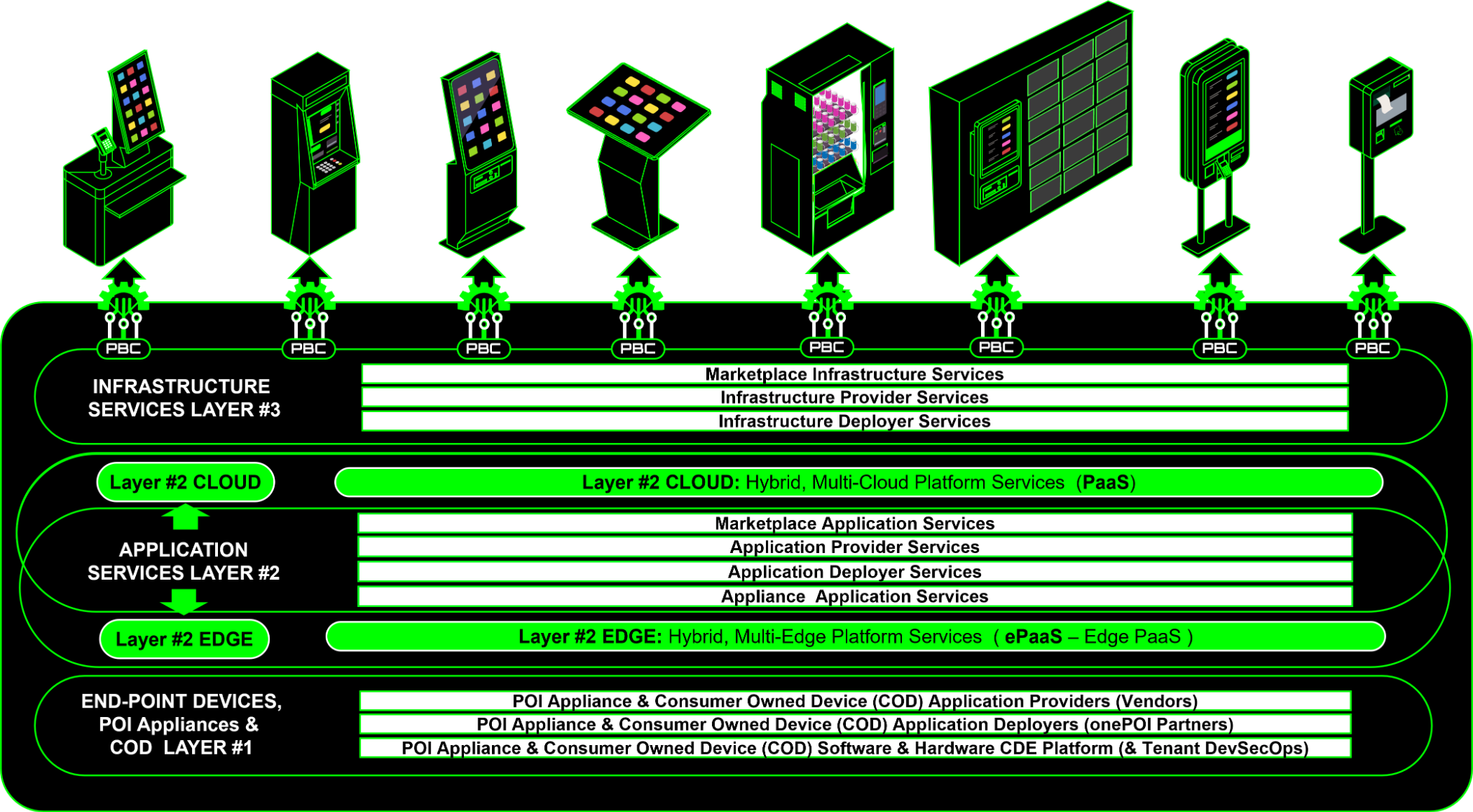
Captures physical interactions across teller counters, smart kiosks, LockerShops, and citizen mobile devices through standardised Packaged Business Capabilities.
Hosted across edge enclaves and sovereign cloud tiers. Implements banking workflows, municipal case management, and parcel hand-offs without direct device tampering.
Network fabric, physical maintenance, secure telemetry, and cryptographic root-of-trust management – shared across all participants without authority conflation.
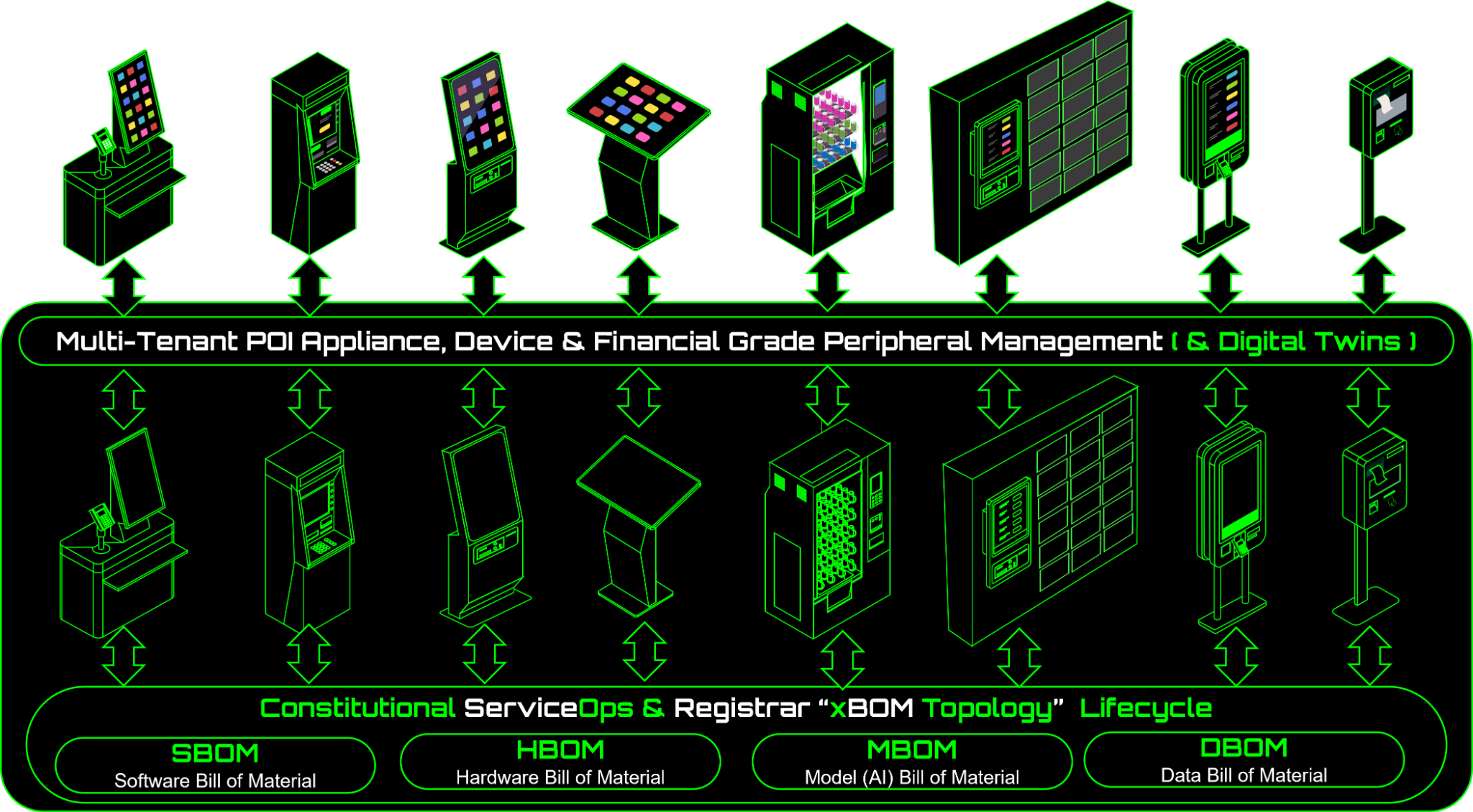
Linked Lifecycle Bills of Materials
Every deployed physical capability maintains an immutable lineage. Software (SBOM), hardware (HBOM), model/AI (MBOM), and deployment (DBOM) topologies are mathematically bound to ensure zero unauthorised peripherals or tampered models can ever execute at the edge.
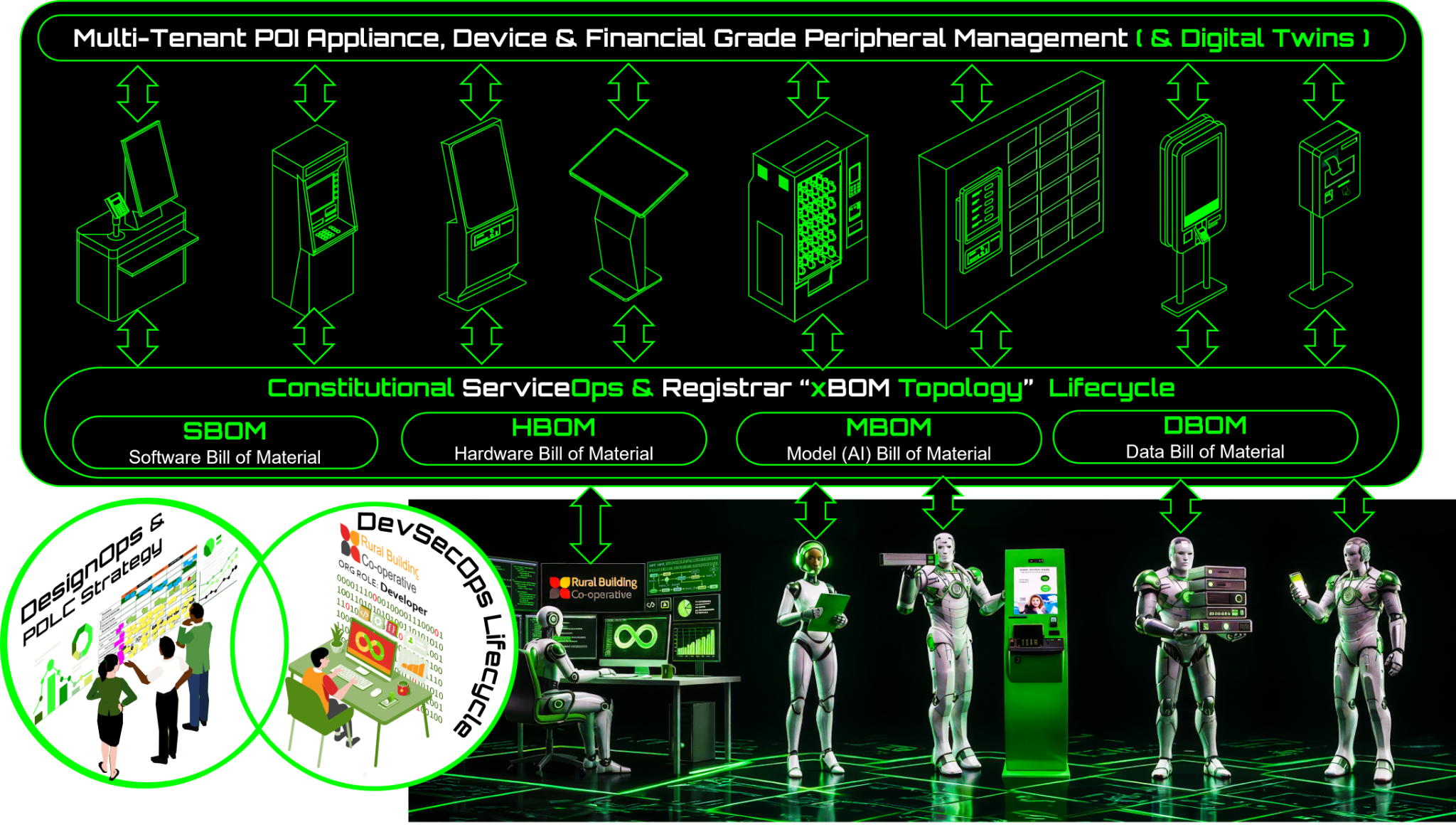
From Intent to Cryptographic Audit
Connects human policy design, continuous integration, and runtime agent execution to the Registrar xBOM. Runtime evidence is harvested continuously, converting regulatory compliance from an intermittent manual audit into an automated bitemporal proof.
Constitutional & Regulatory Invariants by Design
Zero un-consented centralisation of citizen records. Credentials verified using Zero-Knowledge proofs and selective attribute disclosure. Evidence captured once for a defined purpose and discarded.
Multi-vendor peripheral decoupling, seL4 kernel micro-isolation, and local offline fallback ensure critical financial and civic transactions persist during regional network outages.
AI models remain strictly advisory and authority-poor. All consequential decisions (dispensing cash, verifying identity) require deterministic deontic gates (F > O > P) in European-certified TEE silicon.
Monetising Flow vs. Monetising Position
Traditional digital marketplaces focus entirely on Monetising Flow – processing volume, matching transient transactions, and capturing thin transaction fees. This model is highly vulnerable to disintermediation, margin squeeze, and technological commoditisation.
The onePOI.online framework introduces the concept of Monetising Position. By establishing physical trust perimeters (CivicHUB, LockerShop, and POI Appliances) and controlling the sovereign identity registry (Registrar), the platform functions as post-digital real estate. Instead of competing on volume, anchor tenants capture low-risk, high-margin "Trust Tolls" for every hardware-attested, eIDAS-compliant transaction that crosses their physical and digital boundaries.
4-Tier Institutional Crosswalk
| Crosswalk Tier | Operational Layer | Enforced Standard / Primitive |
|---|---|---|
| Tier 1: Sovereign & Regulatory | Legal and regional compliance boundaries | eIDAS 2.0 / GDPR / DORA / PSD3 |
| Tier 2: Consortium & Anchor | Settlement guarantee and multi-rail clearing | SEPA Instant / Switcher+ Gateway |
| Tier 3: Tenant Bank & FSI | Product instantiation and customer profiles | BIAN PBCs (SD-101 to SD-704) |
| Tier 4: Edge Merchant & Citizen | Localised physical interaction and IoT enclaves | POI Appliances / oneWallet.online |
Master Conformance RFP Matrix
Mapping canonical BIAN PBCs directly to API contracts, mandatory provenance metadata, and target acceptance KPI thresholds under the near-term target state architecture (Q4 2026 / 2027 roadmap).
| Capability Group | Canonical BIAN PBC | Key API / Event Contracts | Target Acceptance & KPI Threshold (Q4 2026 / 2027 Roadmap) |
|---|---|---|---|
| Agreement Mgmt | Customer Agreement PBC | GetParty(); UpsertParty() | Canonical ID resolves duplicates; Duplicate rate < 1% |
| Agreement Mgmt | Arrangement Mgmt PBC | POST /agreements/bind | Contract baseline snapshot unchanged; Rate accuracy = 100% |
| Identity & Party | Party Lifecycle PBC | POST /onboarding/initialize | Straight-Through onboarding <= 45s; Manual overhead -92% |
| Identity & Party | KYB & AML Screening PBC | POST /screening/evaluate | eBPF SmartNIC packet block; Sanctions recall = 100% |
| Payments & Clearing | Transaction Enablement PBC | POST /routes/optimise | Multi-rail routing; Transaction fee cost reduction >= 22% |
| Payments & Clearing | Payment Gateway PBC | POST /node/isolate | Offline Island Mode on fiber cut; Limit enforcement <= 100ms |
| Corporate & Trade | Treasury Management PBC | POST /treasury/sweep | Liquidity sweep cycle <= 5 mins; Clearing success >= 99.99% |
| Corporate & Trade | Operational Risk PBC | POST /exceptions/escalate | Fail-closed isolation <= 15us; Mean Time to Veto <= 2h |
Transition to an asset-light composable architecture where legacy cores are ring-fenced behind eBPF membranes and triadic ASIC adjudication. Institutions capture high-margin "Trust Tolls" for every Lawful Warrant, dropping core maintenance costs by >75%.
ISVs hot-swap product logic inside TEE Hardware-Isolated Enclaves using MCP. By separating the "What" (Agreement DAG) from the "How" (Actuator DAG), integration time-to-market is shortened by 85%.
Lived Persona Scenarios: The Value Stack in Live Operation
How financial institutions, enterprise merchants, and civic authorities tangibly capture margin expansion while guaranteeing transistor-level regulatory compliance.
Branch Estate Pooling
Facing expanding physical service deserts and unsustainable single-tenant branch overheads, the bank joins the sovereign pooled infrastructure cohort. Instead of maintaining dedicated high-street branches, the bank deploys teller and KYC services on multi-tenant POI Appliance kiosks shared with competitor institutions and civic bodies. Hardware TEE enclaves ensure absolute data and regulatory separation, slashing operating CapEx by 72% while expanding geographical market reach.
Interchange Toll Bypass
Processing millions of daily checkout transactions burdened by predatory 2–3% card interchange tolls, the retailer connects checkout lanes to the POI Appliance substrate. Transactions settle directly over instant account-to-account rails at a flat €0.10 target fee. Merchant margin expands immediately, and click-and-collect parcel lockers operate on the same shared hardware without cross-tenant data leakage.
Universal Public Touchpoints
Local government deploys Community Hub touchpoints providing cash access, identity onboarding, and civic welfare verification on a single shared appliance. Autonomous island-mode resilience guarantees that even during regional network partitions or grid blackouts, local citizens can securely verify entitlements and access emergency funds under the Constitutional OS.
Commercial viability in the System of Engagement (SoE) TXM Membrane is unlocked by shifting from traditional 2–3% card-scheme interchange rates to a predictable, fixed per-act governance fee model, driving massive adoption for enterprise merchants and financial institutions.
Ready to Explore Your Fit?
For as little as €2,500*, a Discovery & Positioning Workshop maps the Salient Innovation Sets relevant to YOUR objectives, domain and sector, resulting in a "high-level" Report and Slide Presentation. This presents a review of strategic opportunities and cohort fit at a Contextual and Conceptual level before committing limited resources and time further.