You Don’t Just Deploy a Kiosk –
You Build the Sovereign Foundation First
A LockerSHOP is not an isolated, legacy parcel box – it is a hardware-enforced peripheral (POI Appliance) that acts as a physical extension of a cohort's sovereign trust layer using Trusted Execution Environments (TEEs) or "TEE Hardware-Isolated Enclaves" to isolate workloads. Consequently, it cannot be built without first deploying the Minimum Viable Platform (MVP) substrate.
This L1/L2 digital substrate establishes Substantiated Integrity before a single physical door is hung. The founding cohort bootstraps this platform, taking the initial risk to secure a permanent first-mover advantage across the territory.
The MVP Substrate (Day 1)
Axiom MESH Activation
Establishing L1 cryptographic constants and L2 architectural laws like Lossless Enforcement.
Constitutional OS (COS) Nodes
Deploying the decentralised mesh of secure enclaves hosting the policy enforcement points.
Bitemporal Graph Ledger
Activating the immutable System of Record to log every state change via Lawful Act Hyperedges (LAHE).
Redefining the Merchant Footprint
E-commerce convenience has forced local merchants into a losing race. Centralised parcel networks burn massive last-mile delivery costs, while brick-and-mortar stores sit unvisited outside of 9-to-5 working windows.
The onePOI LockerSHOP: We turn standard storefront margins into active, two-way access logistics nodes. Tying dual-access LockerSHOP units (rear-loading for merchant kitchens/stores, front-access for customers) to the platform's System of Engagement, we allow ghost kitchens, pharmaceutical suppliers, and local grocers to aggregate fulfilment asynchronously. Your storefront serves customers 24/7, without requiring front-of-house staff.
Unlock secure LockerSHOP units outside hours using oneWallet biometric tokens.
Rear-loading for merchant inventory; street-facing for consumer retrieval.
Continuous IoT temperature logging sealed Homomorphically in the EventMESH.
Automate collections, returns, and inventory dispatch logs.
LockerSHOP Capabilities
Our platform provides a complete suite of software integrations, hardware APIs, and security enclaves to operate micro-3PL fulfilment.

Multi-Tenant 3PL Integration
Operate "LockerSHOP Malls" where Tier 1 to Tier 4 merchants – a national grocer beside a local bakery, butcher, pharmacy and farm – share a single physical LockerSHOP bank. Orders from different tenants are dynamically aggregated into the nearest vacant LockerSHOP bay allocated to the customer, minimising operational footprint.

In-Transaction Offers (Contextual Upselling)
Powered by the System of Intelligence (SoI) and ISO 20022 metadata. When a customer executes a pickup or payment at the terminal, the system analyses the purchase history to present pre-approved, single-click transactional cross-selling opportunities (e.g. picking up groceries triggers a pharmacy coupon or a micro-mobility voucher).
Augmented POS & CaaS Integration
Transforms the LockerSHOP kiosk into an active Cash-as-a-Service (CaaS) portal. Customers can securely deposit and withdraw cash, converting physical currency into stablecoins or digital credits mapped directly to their oneWallet accounts under strict AMLD6 guidelines.

Anti-Tamper Physical Security
Protects unstaffed physical LockerSHOP units in high-risk areas. Features biometric authentication, UV/IR parcel scanning, 3D computer vision arrays checking for unit volume and weight compliance, and an automatic local lockout gate if structural anomalies are detected.
One LockerSHOP. Every Neighbour.
A LockerSHOP is a Physically Instantiated Jurisdiction in the Constitutional Logistics Mesh – a shared, governed footprint where every local actor meets. The farm, the Tier 4 shop, the Tier 1 grocer, the bank, the clinic and the council all plug into the same LockerSHOP node, each a sovereign tenant isolated in its own Silicon Apartment. The more neighbours that plug in, the more valuable the node becomes for all of them.
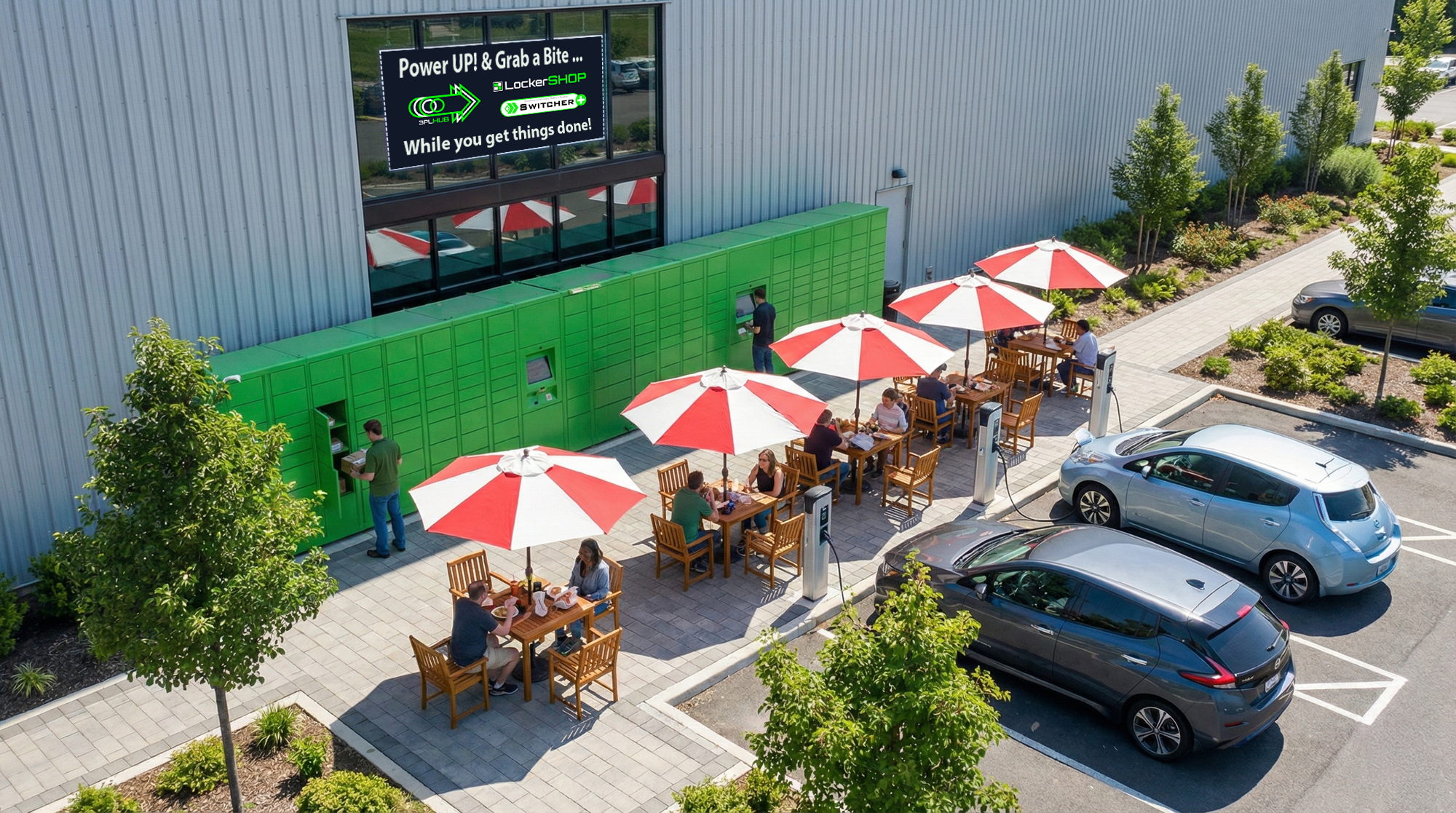
The shared physical precinct: combining automated LockerSHOP bays, electric mobility, and secure multi-tenant service access into one neighbourhood anchor.

Local Agriculture
A regional farm mints a First-Mile electronic Bill of Lading and drops harvest into the rear-loading bay. The Farm-to-Fork pathway ends on the local shelf, not a distant depot.
Retail Tier 1-4
A Tier 1 grocer and a Tier 4 market trader share one locker mall, each isolated cryptographically, both reaching the customer 24/7. The retail ladder shares one fulfilment spine.

Banking HUB
The kiosk becomes a Cash-as-a-Service portal for deposit and withdrawal. On a shared "1 ATM" appliance, a local credit union keeps its brand beside a national bank.

Healthcare HUB
Temperature-guarded bays dispense prescriptions and medical supplies, cold-chain sealed and bitemporally logged, so a rural patient collects safely without a staffed pharmacy counter.

Civic HUB
A council disburses benefit vouchers and accepts document drop-offs through a CivicHUB tenant app, bridging the digital divide on the high street rather than a city-centre office.

Community HUB
Ghost kitchens and co-op cafés assemble multi-vendor baskets into temperature-controlled bays for single-tap collection. One Community HUB, every errand.
The Constitutional Logistics Mesh
One federated architecture spanning First-Party to Fifth-Party logistics, governed by machine-executable law.
Cross-Layer Return Choreography
When a customer returns a multi-vendor basket, the POI parses the token and runs a triadic adjudication pass, releases the latch through a local TEE, verifies weight and volume by computer vision, signs a Graph Mutation Delta, and commits it bitemporally on the Bitemporal Graph Ledger – automatically triggering escrow reversal and refund. No staff, no dispute.

The Non-Citizen Handshake
To admit a transient gig driver securely, the LockerSHOP's eBPF-governed seL4 microkernel verifies transport credentials by zero-knowledge proof and issues a single-use, localised biometric token that releases the warehouse-facing back-door solenoid – expiring the instant the drop is verified. Un-vetted labour, fully governed.
One shared LockerSHOP, governed by constitutional law (Systems Thinking) and designed around the neighbour who actually uses it (Design Thinking). Not one or the other: the two held in harmony is what turns a LockerSHOP node into local infrastructure.
TaxiCash: Transport-Hub LockerShop POI Appliance
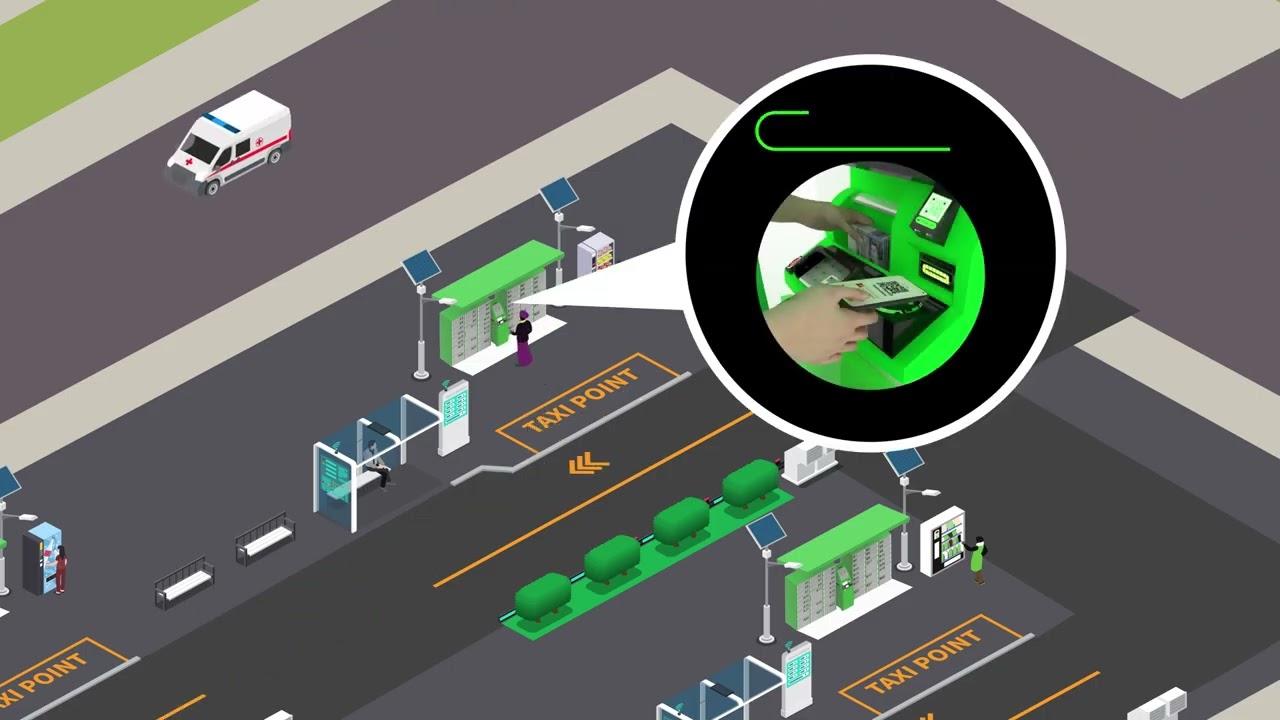
TaxiCash represents a specialised, high-throughput transport-hub adaptation of the broader LockerShop POI Appliance form factor within the onePOI.online multi-tenant Digital Public Infrastructure (DPI). While a standard LockerShop combines automated parcel lockers with basic retail self-service, the TaxiCash variant is engineered specifically to resolve the intense operational, physical, and cash-velocity dynamics of high-density transit ranks, taxi terminals, and intermodal transport interchanges.
Closed-Loop Cash Velocity
Driver fare deposits immediately replenish commuter cash withdrawals and welfare grant disbursements on-site. Armoured Cash-in-Transit (CIT) visits are reduced by up to 90%, slashing operational overheads and returning savings directly to commuters in lower transactional fees.
Grid & Environmental Resilience
Engineered for harsh semi-outdoor terminal conditions with auxiliary solar photovoltaic buffering, vibration-isolated kinetic dampeners, and automated power telemetry that maintains essential cash and locker operations through persistent grid load-shedding.
Key Architectural Variations & Form Factor Adaptations
How the TaxiCash POI Appliance variant adapts the generic LockerShop specification for extreme-density transit ranks.
1. Integrated Kinetic Layer: High-Volume TCRs
Embeds industrial-grade Teller Cash Recyclers (TCRs) and multi-note bundle deposit modules directly within the locker footprint. Operators drop bulk cash in seconds during peak shift handovers, instantly authenticating notes while recycling cash for commuter withdrawals.
2. Closed-Loop CaaS & Liquidity Balancing
Functions as a self-sustaining municipal liquidity loop. Transit cash drops immediately satisfy outgoing cash drawdowns without idle vaulting. Drivers receive instant $T+0$ commercial bank account crediting via real-time A2A rails without paying high cash deposit surcharges.
3. "Morning Order, Evening Collect" Phygital Flow
Optimised for a rapid same-day transit cycle. Unbanked commuters or those without smartphone connectivity place retail catalogue orders at the appliance touchpoint on their morning commute; 3PL couriers replenish lockers mid-day; commuters collect packages on their return trip home.
4. Multi-Tenant TEE "Silicon Apartments"
Hardware-isolated Trusted Execution Environments (TEEs) and eBPF kernel sandboxing partition the appliance into secure "Silicon Apartments". Competing commercial banks, fintechs, telcos, and public entities (SASSA, Home Affairs) run concurrent microservices without telemetry leakage.
5. Environmental & Power Autonomy
Constructed with ingress-protected marine-grade stainless enclosures, conformal coating, and integrated battery buffers. Implements XFS4IoT power governance (Common.PowerSaveControl) to automatically transition kinetic peripherals during rolling blackouts.
6. BIAN & XFS4IoT Universal Standards
Decouples hardware vendor proprietary drivers through standardised XFS4IoT WebSocket services and maps transactions directly to BIAN v14.0 Service Domains (Cash Management and ATM Network Operations), ensuring non-proprietary vendor neutrality.
Comparative Specification Matrix
Standard LockerShop POI vs. TaxiCash Transit Variant
| Capability / Dimension | Standard LockerShop POI | TaxiCash (TaxiCa$h) POI Variant |
|---|---|---|
| Primary Focus | E-commerce delivery, 3PL micro-rentals, basic bill pay | High-volume cash drops, cash recycling, transit hub commerce |
| Cash Handling | Basic deposit/payment acceptor (optional) | Heavy-duty Teller Cash Recycler (TCR) for continuous CaaS recycling |
| Turnaround Time | Multi-day parcel storage window (24–72 hours) | Same-day “Morning Order → Evening Collect” transit flow |
| Multi-Tenancy | Single or limited-tenant logistics software | Multi-tenant TEE “Silicon Apartments” (Banks + SASSA + Retail + Telcos) |
| CIT Dependence | Standard periodic servicing and replenishment | Near-zero due to local circular cash recycling between drivers & commuters |
The PPP Model: Foundational Bedrock for Digital Public Infrastructure (DPI)
Digital Public Infrastructure (DPI) cannot succeed as either an exclusively state-funded project or a fragmented set of private walled gardens. The onePOI.online framework establishes a triadic Public-Private Partnership (PPP) model that transforms capital-intensive physical transit ranks into shared civic utilities:
Municipalities & Civic Agencies
Provide transit land rights, rights-of-way, and regulatory mandates. Public bodies deploy essential social grant payouts (SASSA), ID verification (Home Affairs), and municipal utility revenue collection without capital expenditure on dedicated brick-and-mortar civic offices.
Banks, 3PLs, Telcos & onePOI
Fund, deploy, and maintain the pooled POI hardware and edge network. By sharing the physical footprint through hardware-isolated TEEs (“Silicon Apartments”), private tenants achieve a 70% reduction in physical servicing TCO while accessing massive transit footfalls.
Taxi Associations & Commuters
Provide daily physical liquidity anchoring. Taxi operators eliminate cash robbery risks through bulk drops, while millions of commuters gain access to dignified, low-fee cash withdrawals, bill payments, and same-day parcel collections at the transport rank.
By weaving together transit liquidity, automated retail lockers, and multi-tenant banking into a single constitutional appliance, TaxiCash turns the taxi rank from an informal cash vulnerability into the most resilient, high-velocity node of the national Digital Public Infrastructure.
Turn Local Fulfilment into Shared Infrastructure
Last-mile delivery is ecologically and commercially broken when multiple courier vans visit the same rural street each morning. The LockerSHOP and 3PLHUB network turns local fulfilment into shared, multi-carrier infrastructure – combining shared inventory buffers, two-way reverse logistics, and high-capacity corridor nodes.
Shared Inventory & Pick-and-Pack
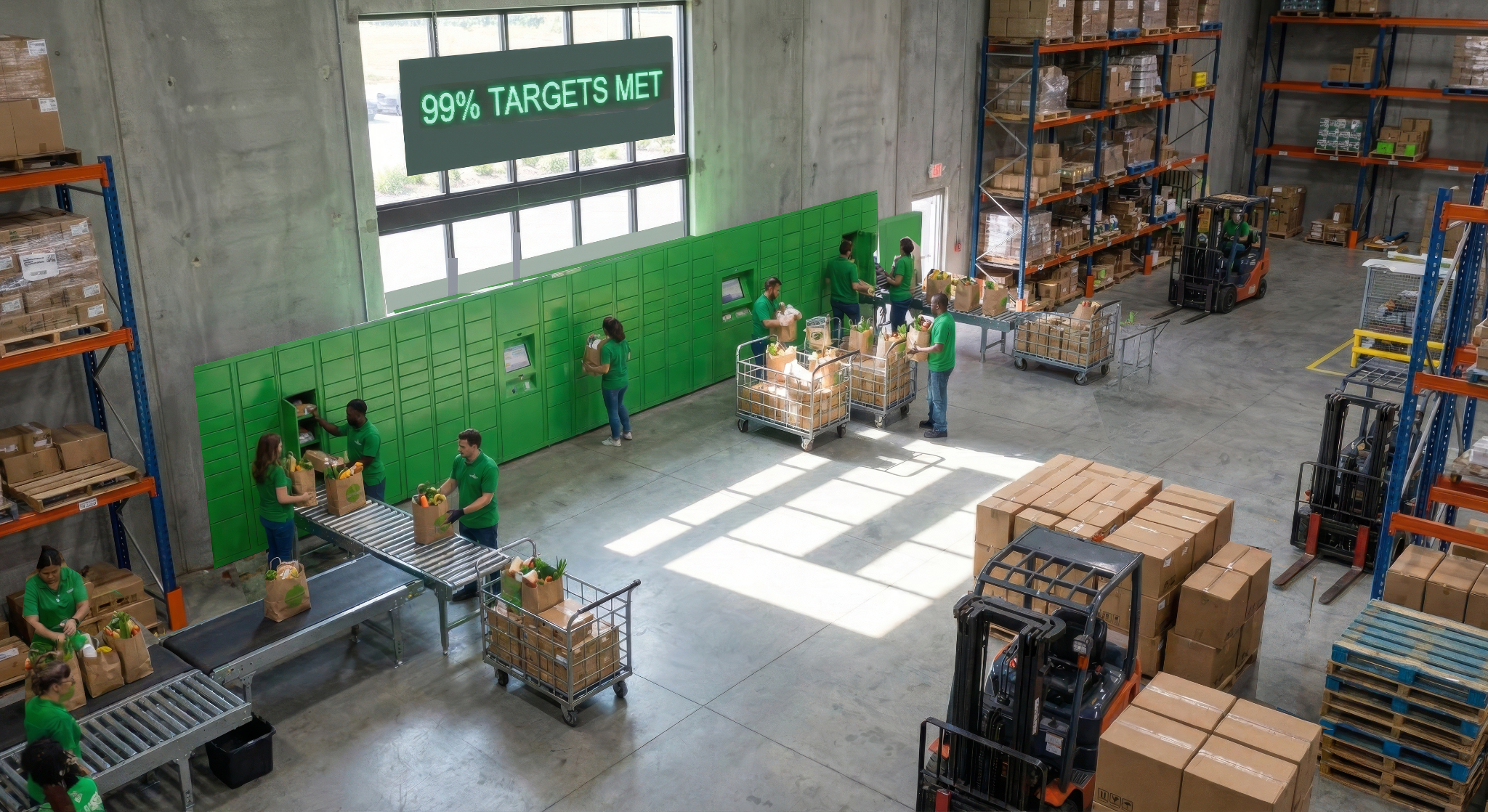
Local merchants store high-velocity items in shared back-of-hub micro-warehouses. Automated pick-and-pack systems load lockers from the rear while customers collect from the secure front arcade.
Two-Way Reverse Logistics
LockerSHOP is explicitly two-way: supporting customer returns, municipal document hand-overs, pharmacy prescription drops, and tool repair dispatches without requiring staffed counter desks.
Embedded Community Logistics
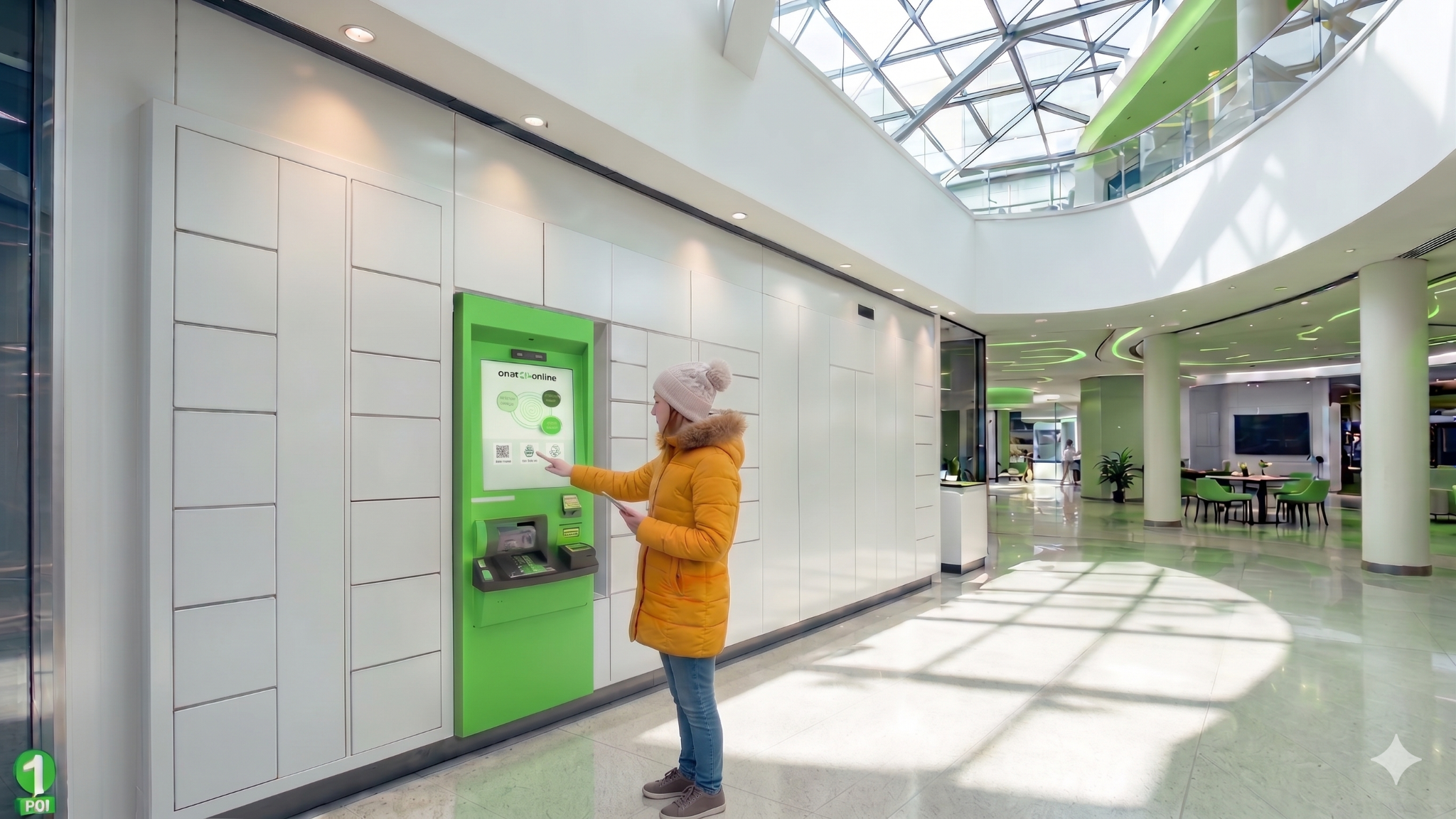
Secure collection embedded into an existing bank branch, CommunityHUB, post office, or employer campus. The unit inherits physical security and accessibility from the host facility.
EV Charging + Micro-Fulfilment
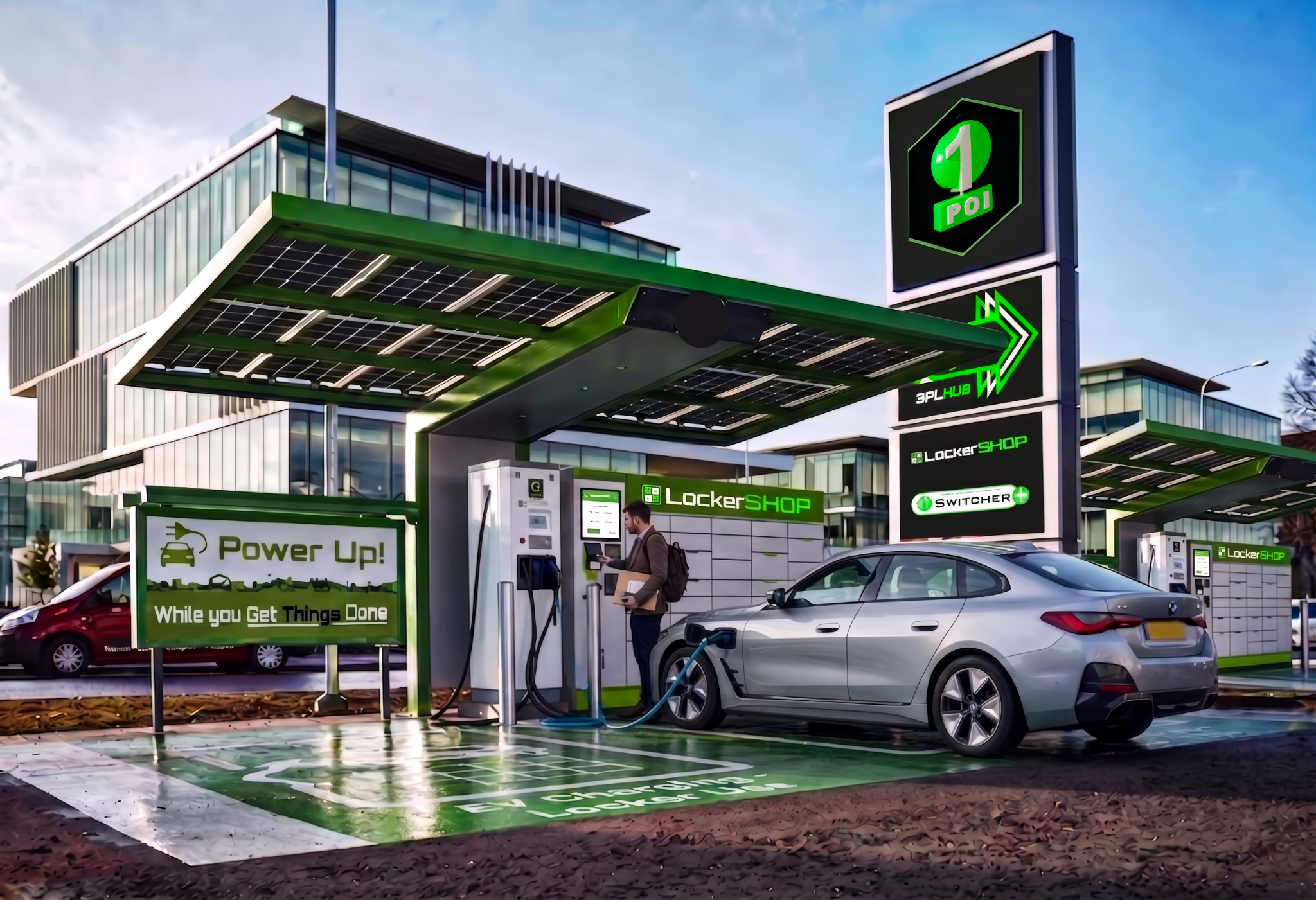
Commuters charge electric vehicles while retrieving parcel bundles or completing financial transactions. Shared grid connections, high-voltage battery storage, and edge compute amortise infrastructure capital costs.
Architectural Blueprint & Invariants
Deep-dive technical details on LockerSHOP control circuits, bitemporal telemetry logging, and credential privacy gates.
CIT-Grade Solenoid Control, 2-Way Rear Loading & Dual UHD 3D AI Camera (T4 Spec)
LockerSHOP bay doors are secured using double-sided CIT-grade physical latch solenoids, controlled through a secure local FPGA interface board. The system utilises real-time FPGA logic traversal to audit latch status independent of the master OS.
2-way rear-loading pass-through doors allow secure Cash-in-Transit (CIT) couriers, agricultural producers, and 3PL partners to load lockers from back-of-house micro-marts and civic hubs without entering customer-facing zones. Dual UHD 3D AI stereoscopic cameras perform internal volumetric scanning during door closure, automatically computing payload dimensions and flagging anomalous package shapes.
Rear-loading (merchant side) and front-access (customer side) latch commands must be validated by the local TEE enclave. If a front-door release command is received while the rear door is open, the FPGA locks execution paths and alerts local security, preventing visual or physical compromise of the back-of-house storage space.
IoT Telemetry Snapping & Bitemporal EventMESH Logging (T4 Spec)
Cold-chain temperature sensors continuously output telemetry data. The local onePOI Bridge converts these raw temperature logs into BIAN-aligned message structures and "snaps" them to the central KnowledgeHUB Ontology.
These logged events are timestamped bitemporally with Valid-Time ($T_V$ - when the temperature was measured) and Transaction-Time ($T_X$ - when it was written to the ledger). The resulting record is signed homomorphically and locked inside the EventMESH, providing a permanent, audit-ready proof trail that prevents dispute of temperature or food safety compliance.
PAIF Cryptographic Shredding & Privacy Gates (T5 Spec)
Under the Personal Agent Instruction Framework (PAIF), customer data and credentials are cryptographically protected. During LockerSHOP pick-up verification, oneWallet interacts with the kiosk via Zero-Knowledge selective disclosures, proving that the user holds the authorisation token without revealing their name or date of birth.
Once the parcel is successfully collected and verified, the ephemeral decryption keys for the customer transaction details are automatically destroyed inside the local HSM via PAIF Cryptographic Shredding. This guarantees GDPR compliance for right to erasure while leaving the parent transaction's ZKP verification proof intact on the public ledger.
Field → Finance → Shelf → Neighbour
LockerSHOP is not one stage in the continuum. It is the rail the whole continuum runs on, carrying value through every stage and every tenant cohort.
Every stage of the continuum passes through one physical rail. The field's First-Mile drop-off, the bank's cash access, the shelf's fulfilment and the neighbourhood's collection all travel through the LockerSHOP and 3PL HUB. It is the connective tissue that lets four hand-offs read as one motion.