Breaking the Monolithic Terminal Lock
For Global Merchants, Tier-1 Financial Service Institutions (FSIs), and Communication Service Providers (CSPs), the point of interaction has historically represented an operational bottleneck. Monolithic Point of Sale (POS) terminals conflate payment kernels, device drivers, proprietary operating systems, and business logic into closed black boxes. Upgrades require expensive, protracted 18-month hardware certification cycles, multi-acquirer routing remains technically unavailable on single devices, and compliance remains a post-hoc liability managed through insurance reserves and dispute arbitration.
The Legacy Terminal Vulnerability
Fragile & Monolithic- Hardware Firmware Conflation: Payment kernels (EMV L2), peripheral drivers (printers, scanners), and checkout UIs share single execution memory, requiring full re-certification for UI tweaks.
- Proprietary Acquirer Lock-In: Hardware devices are tied to single acquiring processors, forcing multi-lane merchants to operate redundant physical terminals per scheme or acquiring contract.
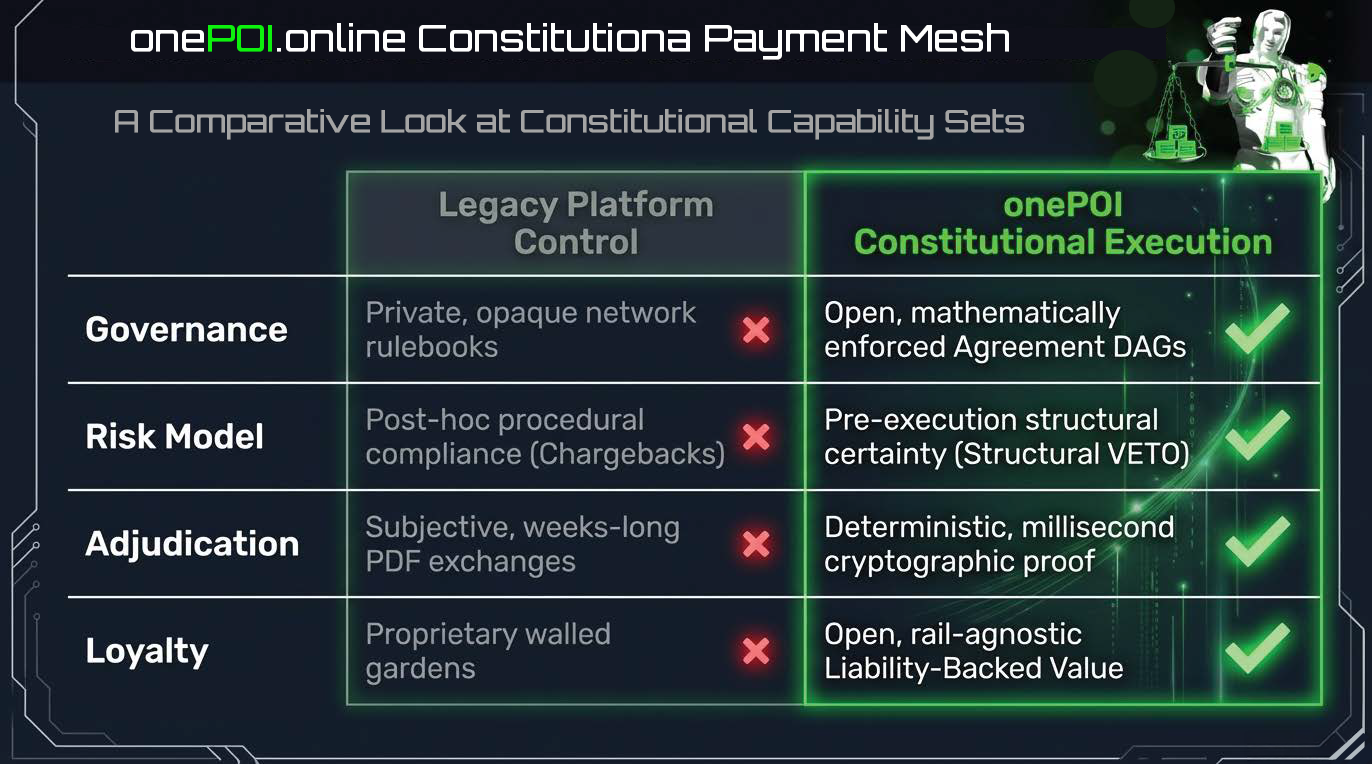
- Post-Hoc Fraud & Settlement Tax: Fraud detection relies on post-event statistical heuristics and chargebacks, imposing 2.5% to 3.5% interchange friction and 90-day dispute tails.
- Blind Edge Execution: Terminals act as dumb IO relays with zero real-time legal awareness, rendering autonomous agentic commerce structurally insurable.
The Sovereign Phygital Breakthrough
Constitutional & Modular- Decoupled EMVCo C-8 Architecture: Contactless kernels execute as isolated micro-services wrapped in XFS4IoT standards, allowing complete UI decoupling and zero-firmware re-certification.
- Hardware TEE Silicon Apartments: Multi-tenant isolation enables FSIs, retailers, CSPs, and civic operators to run un-trusted code side-by-side on one universal physical appliance.
- Real-Time Pre-Execution Warrants: The DRAGON Adjudication Engine evaluates deontic Agreement DAGs ($< 500 \ \mu\text{s}$ target metric, Q4 2026 roadmap), rendering unlawful or un-consented execution physically impossible.
- Multi-Rail Instant Settlement: Direct A2A rails (PayShap, SEPA Instant, FedNow) bypass interchange taxes, achieving sub-second deterministic balance-sheet clearing.

Payment Architecture Runtime Manifest
Near-term target state specifications for 5th-Generation Payment Mesh execution, warrant adjudication, and instant A2A rail routing.
Business Domain & Runtime Capabilities
The 5th-Generation Payment Architecture operationalises the Universal Surface across phygital touchpoints, transforming passive checkout counters into sovereign point-of-interaction (POI) computing appliances with zero firmware lock-in and deterministic compliance.

Zero-Firmware-Lock Agility
Decouple payment terminals from proprietary firmware cycles. Deliver instant over-the-air micro-frontend updates without invalidating EMVCo Level 2 certifications or touching secure peripheral stacks.

Flat-Fee Real-Time Rails
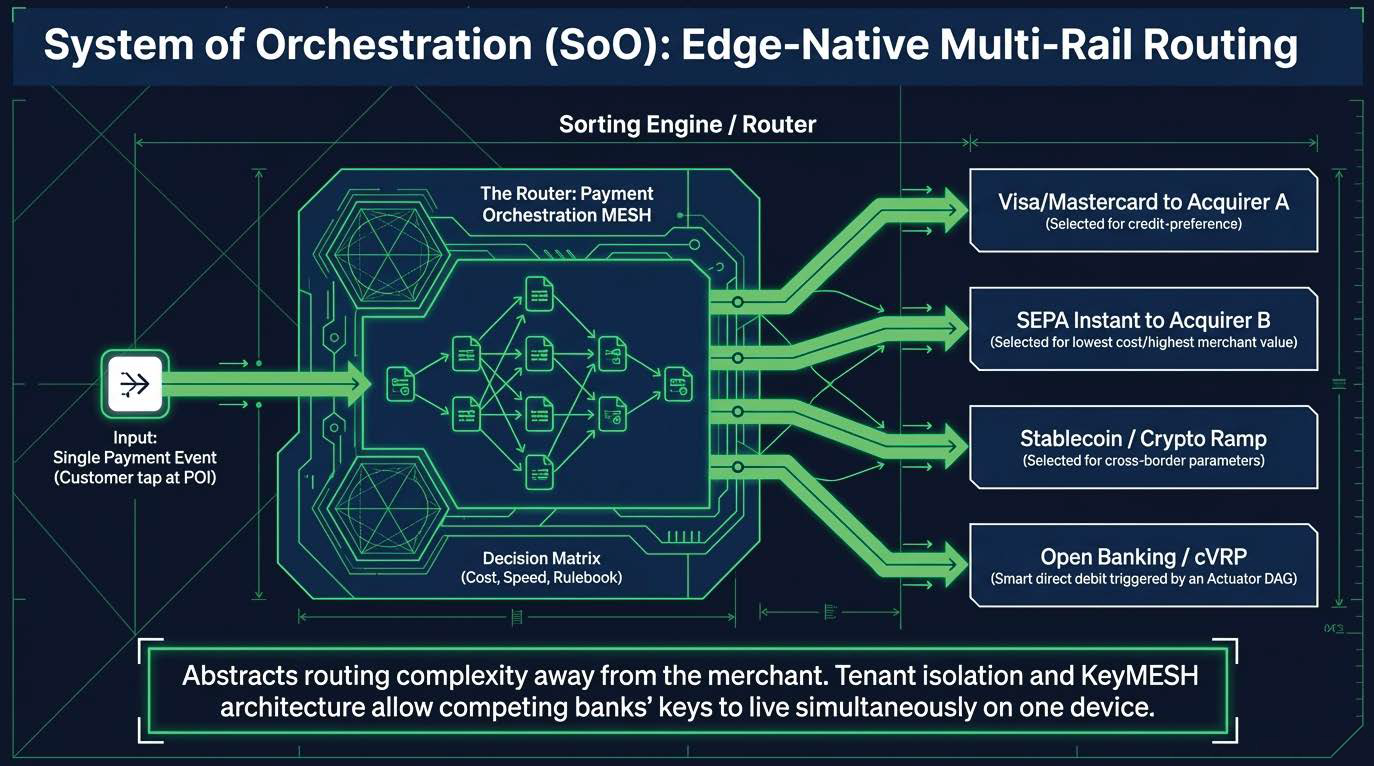
Bypass expensive interchange monopolies. Switcher+ dynamically routes transactions across domestic instant rails (PayShap, SEPA Instant, FedNow) with deterministic balance-sheet clearing.

Deterministic Regulatory Moats
Replace retroactive audit logs with mathematical certainty. DRAGON evaluates deontic dominance orders at the point of tap, generating unforgeable Evidence Bundles that satisfy DORA and PSD3.

Autonomous Agentic Commerce
Empower autonomous AI agents to execute commercial transactions within cryptographically enforced spending boundaries, mandate timeouts, and On-Behalf-Of (OBO) legal delegacy tokens.
Core Architectural Topologies & High-Resolution Visualisation
Inspect the end-to-end topological fabric connecting decoupled phygital hardware, silicon-level multi-tenant isolation, real-time constitutional adjudication, and federated bank settling cores.
5th-Generation Decoupled Acceptance & Multi-Mesh Super-Node
Constitutional Payment Mesh Topology
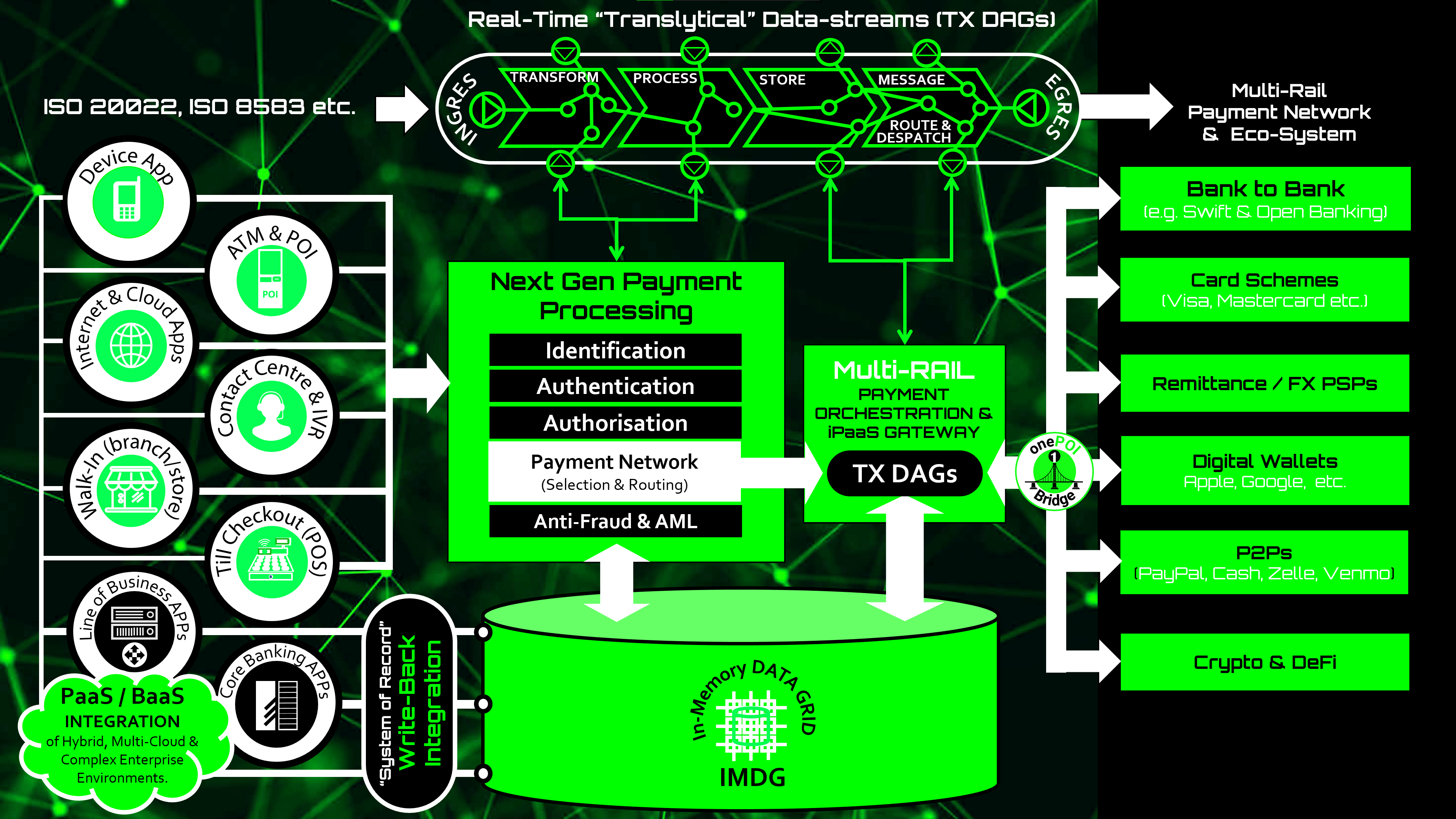
The payment mesh bridges edge point-of-interaction appliances directly into cloud-native core banking engines. By decoupling the presentation layer from the secure execution core, single appliances host multiple concurrent institutional tenants without cross-contamination.
The Decoupled Phygital Acceptance Engine
The core of 5th-Generation payment engineering lies in breaking traditional physical-to-digital boundaries. By separating physical device interaction, contactless card kernel processing, and checkout presentation logic, the architecture enables modular certifications and unconstrained customer journey experimentation.
1.1. EMVCo C-8 Contactless Kernel
Integrates the universal EMVCo Contactless Kernel (C-8), replacing legacy brand-specific kernels (Visa PayWave, Mastercard PayPass, Amex ExpressPay) with a unified, independent micro-service. Validated on hardware-isolated peripheral chips to ensure sub-500ms tap-to-approval times while slashing compliance costs.
1.2. PBC-Wrapped XFS4IoT FGPs
Peripheral devices (PIN pads, card readers, biometrics, cash recyclers) expose standardised XFS4IoT REST and WebSocket interfaces. These peripherals are wrapped into Packaged Business Capabilities (PBCs), making them accessible securely across local area networks via hardware-level mutual TLS (mTLS).
1.3. nexo FAST Architecture
Natively supports the nexo FAST (Financial Application Standard) specification, guaranteeing protocol interoperability across acquiring gateways globally. This eliminates proprietary terminal-to-host messaging formats, allowing merchants to point their acceptance engines to any acquirer instantly.
The Multi-Tenant Super-Node Infrastructure
The onePOI Super-Node transforms traditional single-purpose terminals into a shared, high-assurance compute fabric. By virtualising the payment terminal, multiple commercial, banking, and public-sector tenants execute concurrently on a single physical footprint.

2.1. Silicon Apartment Isolation
Utilising Hardware Enclaves (ARM TrustZone, Intel SGX, AMD SEV-SNP), the appliance runs multiple “Silicon Apartments.” A tier-1 retail bank, a local boutique merchant, and a public transport operator coexist on the same appliance with mathematical cryptographic isolation.

2.2. Micro-Frontends (No Lock-In)
The user experience is completely detached from the core payment engine. Merchants deploy reactive web micro-frontends (React, Vue, Web Components) running inside sandboxed browsers, styling their checkouts freely without affecting the underlying PCI-PTS certified cryptographic boundary.

2.3. Multi-Cloud Mesh Federation
Super-Nodes federate securely with multi-cloud payment backbones and edge nodes (MEC). Outages in one acquirer or cloud provider automatically trigger local fallback mechanisms, executing offline risk limits enforced directly by local hardware certificates.
Core Mechanics & Deep Technical Execution Pipeline
Every tap, scan, and settlement across the 5th-Generation Payment Architecture executes as a state transition over a formally verified mathematical topology. Unlawful transactions are not simply rejected; their execution is structurally unavailable.
Deontic Dominance Lattice
Deontic LogicRegulatory prohibitions ($\mathbf{F}$) dominate obligations ($\mathbf{O}$) and commercial permissions ($\mathbf{P}$). If sanctions checks, AML velocity limits, or PSD3 consent expirations detect a conflict $\varphi$, the transaction transition is structurally blocked from the reachable state space $\Sigma_{\text{lawful}}$.
Cryptographic Lawful Warrant
Ed25519 / DilithiumDRAGON signs a hardware-rooted Lawful Warrant $\mathcal{W}$ binding transaction payload $H(\text{Tx})$, active Agreement DAG hash $H(\text{DAG})$, and bi-temporal coordinates ($T_V \otimes T_T$). Without $\mathcal{W}$, peripheral actuators (printers, EMV pinpads) refuse actuation.
Bi-Temporal Hypergraph Commit
Audit TopologyTransactions are recorded simultaneously across valid real-world business time ($\tau_{\text{valid}}$) and immutable system recording time ($\tau_{\text{transaction}}$). Post-hoc audits query exact historical system state without destructive rollback or re-indexing penalties.
Multi-Party Flat Colimits
Category TheoryMulti-tenant settlement state achieves deterministic convergence via category-theoretic colimits over commutative diagrams, ensuring all tenant ledgers reach mathematical consensus without central database locks.
Deterministic Payment Execution Pipeline (Tap-to-Ledger State Machine)
< 500 μs Edge Warrant Target
[Customer Tap / Scan] → (EMVCo C-8 Contactless Kernel / XFS4IoT FGP)
           ↓
[Silicon Enclave Boundary] → Hardware TEE Mutual Attestation (mTLS)
           ↓
[Agreement DAG Traversal] → Evaluates Deontic Rules (F ≻ O ≻ P)
           ↓
[DRAGON Engine Warrant] → Generates Ed25519 / Dilithium Cryptographic Warrant (< 500 μs)
           ↓
[Switcher+ Rail Fulfilment] → Selects Optimal Settlement Rail (SEPA / PayShap / FedNow / CBDC)
           ↓
[BIAN v14 Core Settlement] → Executes Bare-Metal Balance Sheet State Mutations
           ↓
[Bi-Temporal Ledger Commit] → Appends Immutable Evidence Bundle (Tv ⊗ Tt)
Salient FinTech Innovation Set & BIAN Substrate Unity
Every interaction across the broader Salient Innovation Set – whether in healthcare, smart cities, connected retail, or industrial logistics – ultimately resolves into a lawful value exchange, identity attestation, or fiduciary obligation. The Salient FinTech Innovation Set provides the non-negotiable trust engine that powers the entire sovereign ecosystem.
170 BIAN Service Domains
Direct bare-metal compilation into canonical BIAN v14.0 Service Domains (Payment Execution, Clearing and Settlement, Party Authentication, Position Keeping), eliminating translation layers and proprietary middleware.
Explore BIAN SubstrateDirect Real-Time Rails
Zero-intermediary settlement via PayShap, SEPA Instant, FedNow, and Pix. Payments clear with finality in milliseconds, decoupling merchants from card network interchange fees and rolling reserves.
Switcher+ ArchitectureToken Gantry & oneWallet
Cryptographic exchange membrane managing hybrid network tokens, On-Behalf-Of (OBO) delegacy tokens, and sovereign oneWallet digital asset balances with hardware-anchored spending velocity caps.
Token Gantry Deep-DiveNext-Gen Remittance: Multi-Rail Settlement & Cross-Border ISO 20022 A2A Rails
Legacy cross-border remittances remain hampered by opaque correspondent banking tiers, multi-day settlement delays, predatory foreign exchange margins, and fragmented message formats. Powered by the Salient FinTech Innovation Set at its core, the Next-Gen Remittance (v2.1) architecture bypasses legacy SWIFT correspondent hops through direct, bilateral account-to-account (A2A) corridors. Leveraging ISO 20022 native data dictionaries and instant clearing rails (including PayShap, SEPA Instant, and FedNow), value moves with mathematical finality in milliseconds. Every foreign exchange rate is discovered in real time, and every credit is cryptographically attested on an immutable bitemporal ledger – guaranteeing zero unhedged liquidity risk and full statutory compliance.

GreenOps & ESG FinOps 2.0 Convergence
Modern financial infrastructure must account for environmental externalities at runtime. The Salient FinTech Innovation Set integrates environmental constraints directly into the Agreement DAG lattice.
Constitutional Runtime Carbon VETO
GreenOps Autonomous GovernanceEvery transaction carries real-time embodied and operational carbon telemetry ($g\text{CO}_2\text{e}$). When localized grid carbon intensity crosses statutory or cohort thresholds, DRAGON activates a constitutional Carbon VETO, automatically routing batch or non-critical settlements to carbon-negative cloud nodes or off-peak green windows.
Real-Time ESG FinOps Evidence
CSRD & Taxonomy CompliantFinancial balance-sheet mutations are cryptographically co-indexed with verified carbon offsets and energy certificates. Institutional tenants receive automated, auditable CSRD and EU Green Taxonomy compliance evidence bundles directly embedded into their bi-temporal accounting ledgers.
Ecosystem Workflows: Cohort Advantages
By embedding financial and commercial rules directly into the underlying hardware circuitry, the onePOI Super-Node unlocks differentiated value across all institutional tenant cohorts.

3.1. Financial Service Institutions
Trust-as-a-Service & Risk Deflection
Banks transition from low-margin utility pipe providers to high-value orchestrators of trust. By hosting an encrypted “Banking Apartment” on multi-tenant Super-Nodes, FSIs provide real-time KYC, biometric verification, instant account-to-account (A2A) lending, and automated risk scoring directly at the merchant checkout counter.

3.2. Retail Merchants
The Community Kiosk Revolution
Retailers collapse multi-vendor hardware footprints into a single device. One counter appliance processes traditional card payments, acts as a high-security cash deposit station, provides utility bill pay, and dispenses transit tickets – drastically lowering CapEx while turning cashiers into localized multi-revenue service hubs.

3.3. Telecoms & CSPs
MEC Edge Infrastructure Monetisation
Telecom providers leverage Multi-Access Edge Computing (MEC) assets to deliver ultra-low latency transaction routing. By hosting DRAGON adjudication engines inside edge base stations, telcos offer sub-millisecond Compliance-as-a-Service (CaaS) as a target state architecture (< 500 μs target metric, Q4 2026 roadmap).

3.4. Consumers & Citizens
Sovereign Identity & Privacy Preservation
Users interact with POI appliances using cryptographic Zero-Knowledge Proofs (ZKPs) emitted from their personal oneWallet. Identity verification, age attestation, and payment execution occur without exposing raw account numbers, government IDs, or sensitive PII to merchants or third-party acquirers.
Seven Ranked Foundational Innovations
How agreement-based execution and hardware certainty transform payment acceptance from a high-tax legacy cost centre into an insurable, deterministic trust engine.

Authority Lives in the Agreement
Legacy systems delegate terminal behaviour to remote back-ends or static firmware configurations. In 5th-Gen Payment Architecture, authority resides exclusively within the Agreement Directed Acyclic Graph (Agreement DAG). The DAG governs cardholder interaction, peripheral actuation, and routing rules with zero reliance on cloud availability.

Unlawful Execution is Unavailable
Traditional compliance operates post-hoc through audit logs and dispute workflows. DRAGON evaluates deontic dominance at the silicon boundary before kernel execution, rendering unauthorised operations structurally impossible. A terminal cannot execute an un-consented fee or un-warranted surcharge.

Constitutional Delegation & Agent Liability
As autonomous AI buyers and autonomous point-of-sale agents interact, liability requires strict legal delegation. The architecture binds machine transactions to cryptographic On-Behalf-Of (OBO) legal delegacy tokens with strict mandate scopes, velocity limits, and automated revocation triggers.
Lawful Execution at the Counter
Payment acceptance is an edge problem. Cloud latency, jitter, and connectivity blackouts cannot halt physical commerce. By packaging full Agreement DAG adjudication, tokenisation, and EMVCo C-8 execution directly inside the appliance, transactions execute locally with full cryptographic certainty.
Many Tenants, One Appliance
Legacy retail counters are cluttered with multiple proprietary terminals, scanners, and printers for different payment types or acquirers. Silicon Apartment isolation allows banks, retailers, loyalty schemes, and public services to share a single physical point of interaction with certified cryptographic separation.

Flat Clearing & Sovereign Wallet
Replaces toll-booth interchange hierarchies with flat-fee, deterministic A2A clearing. Paired with the sovereign oneWallet, consumers retain total control over credentials and identity attributes while merchants receive guaranteed funds with immediate settlement finality.

Replay as a Product, Not a Log
Bi-temporal state capture ensures every execution is perfectly replayable. Insurers, regulators, and auditors verify compliance deterministically using cryptographic Evidence Bundles.
Switcher+ & Entitlement Continuity
Switcher+ fulfils multi-rail flows across payment channels without breaking entitlement continuity, session context, or transaction state machines across handoffs.
Institutional Standards Crosswalk
Native crosswalks map BIAN service domains, ISO 20022 message schemas, and W3C Verifiable Credentials directly into execution-level Agreement DAG nodes.
The Phygital Value Realisation Core
The true differentiation of the 5th-Generation Architecture is its ability to deliver programmable commercial logic without compromising compliance or performance.

Open Loyalty Framework
Loyalty logic executes directly at the hardware layer via Agreement DAG rules. Points, rewards, and tiered discounts settle atomically alongside payment authorisation – eliminating standalone loyalty scanners and proprietary apps.
Open Claims & Arbitration
Automated smart dispute resolution built on deterministic evidence bundles. Chargebacks and claim disputes resolve instantaneously through cryptographic proof replay, eliminating administrative dispute fees.

Open Certification & Attestation
Real-time hardware and software posture attestation. Devices continuously prove integrity to acquirers and scheme networks, preventing physical tampering and terminal cloning attacks.
Mathematical Derivation: Constant-Time Reachability in Agreement DAGs
Given an Agreement DAG $\mathcal{G} = (V, E)$, each vertex $v \in V$ represents a deontic state typed as Prohibition ($\mathbf{F}$), Obligation ($\mathbf{O}$), or Permission ($\mathbf{P}$). The topological reachability matrix is pre-computed into hardware bit-vectors:
Because the dominance order $\mathbf{F} \succ \mathbf{O} \succ \mathbf{P}$ is monotonic over the Boolean ring of bit-vectors, any active regulatory prohibition triggers an immediate hardware branch exit in $O(1)$ constant time, completing edge adjudication in under $500 \ \mu\text{s}$ (target metric, Q4 2026 roadmap).
Cryptographic Evidence Bundle & DORA Proof Replay Formalism
Under DORA Article 28 and PSD3 Strong Customer Authentication (SCA), transaction authenticity must withstand post-incident scrutiny without trusting operator logs. An Evidence Bundle $\mathcal{E}$ is constructed as a cryptographic Merkle-Mountain Range (MMR) accumulator:
The audit verifier evaluates $\operatorname{Verify}(\mathcal{E})$ against the public key of the appliance hardware root of trust. Replay execution guarantees deterministic reproduction of the exact legal state under which the payment was authorised.
Move Beyond Passive Monitors: Join the Certainty Economy
Managing transaction networks through reactive, post-transaction software patches is no longer financially or operationally viable. The onePOI.online Constitutional Operating System turns payment acceptance into an active, hardware-enforced compliance and execution engine.
Partner with onePOI.online to eliminate compliance liabilities, disintermediate legacy transaction fees, and unlock next-generation phygital customer experiences across your enterprise network.
Unifying Phygital Merchants, Switcher+ Rails & FSI Banking Cores
How our decoupled payment execution architecture closes the loop between point-of-sale customer experiences, autonomous orchestration rails, and regulated institutional back-ends.
Merchant +ONE
The universal Point of Interaction (POI) appliance at the physical-digital boundary. Silicon Apartment isolation hosts EMVCo C-8 contactless kernels, micro-frontends, and biometric authentication side-by-side with zero cross-tenant contamination.
Payment Architecture & Switcher+
iEngine proposes optimal routing, DRAGON adjudicates policy compliance, Conductor executes state machines, and Switcher+ provides deterministic rail switching across SEPA Instant, PayShap, FedNow, cards, and Token Gantry digital assets.
FSI Core Infrastructure
170 BIAN canonical Service Domains execute bare-metal balance sheet settlement. Live transaction telemetry allows FSIs to deploy real-time credit underwriting, automated DORA risk attestation, and instant liquidity balancing directly to edge appliances.
The End-to-End Value Journey
From customer tap on Merchant +ONE hardware, through constitutional Agreement DAG evaluation and Switcher+ multi-rail fulfilment, to bare-metal BIAN balance sheet commit – zero proprietary lock-in at any stage.