Governed Executive Workflow Orchestration & Lossless Enforcement
The Conductor represents a fundamental departure from traditional, imperative orchestration tools (such as Jenkins, Airflow, or raw Ansible scripts), which are brittle, opaque, and disconnected from constitutional law. In legacy architectures, automation scripts frequently drift from written policy, creating severe security vulnerabilities and compliance audit failures.
In the onePOI.online Constitutional OS, the Conductor enforces Lossless Enforcement: an unbroken, cryptographically verified chain of custody flowing from foundational truths in Axiom MESH through governing Agreement DAGs to executable Actuator DAGs. The Conductor is strictly logic-blind and authority-poor; it cannot alter a single database record, deploy a container, or fire a mechatronic relay without first verifying a non-repudiable Lawful Warrant emitted by the DRAGON Adjudication Engine.

Conductor Runtime Manifest
Deterministic State Orchestrator
Commercial Sovereignty & Resilient Transaction Integrity
Enterprise systems fail most dangerously when automation operates with unconstrained agency or when distributed networks experience partial partition. By architecting orchestration around formal state machines and reversible Saga patterns, the Conductor automates complex multi-party operations across banking cores, retail networks, and edge terminal fleets while guaranteeing complete regulatory defensibility under DORA and ISO 20022 frameworks.
As the execution engine of the Salient FinTech Innovation Set, the Conductor orchestrates BIAN v14 Service Domains (`Payment Execution`, `Clearing & Settlement`, `Position Keeping`), real-time A2A rails, and Token Gantry asset transfers. If a transaction fails mid-flight, pre-authorised Contrary-to-Duty (CTD) Compensating Stanzas roll back partial state across all nodes, guaranteeing that customer assets are never stranded in an inconsistent state.
Lossless Enforcement
Every technical action is provably bound to an Agreement DAG statute and an Axiom MESH constitutional invariant.
Automated Sovereign Sagas
Executes mathematically verified forward actions and reverse compensations (CTD), guaranteeing zero database drift.

Zero Excessive Agency
Eliminates OWASP LLM06 vulnerabilities; AI agents propose intents, but only the Conductor executes upon DRAGON warrant.
Predictive FinOps Scaling
Subscribes to System of Intelligence (SoI) causal forecasts to proactively allocate or decommission edge compute resources.
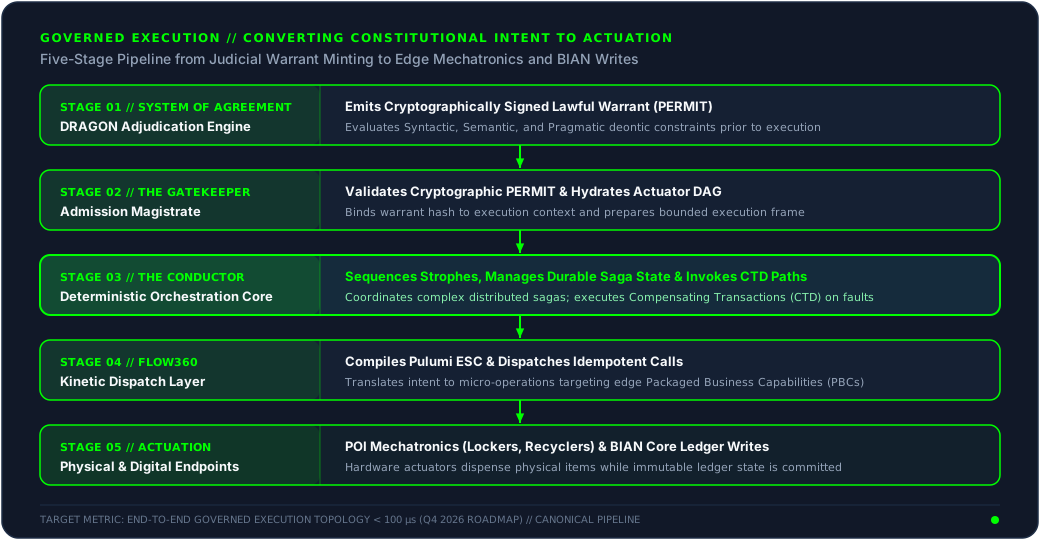
The Subsystem Triad of the System of Orchestration
Within the System of Orchestration (SoO), execution responsibilities are partitioned into three distinct capability sets with rigid, mathematically protected boundaries.
The Gatekeeper
The inward-facing security boundary and constitutional checkstop. Holds inbound Actuator DAGs in strict HALT until a signed DRAGON PERMIT is validated, then "hydrates" the token by binding it to the parent Agreement DAG's Intent Frame.
The Conductor Core
The middle-out macro-orchestration hub. Sequences multi-step workflows, enforces idempotency, tracks durable state transitions across temporal sagas, and triggers Contrary-to-Duty (CTD) compensating paths upon execution faults.
Flow360
The omnidirectional, outward-facing kinetic dispatcher. Dispatches idempotent system calls to target Packaged Business Capabilities (PBCs) and edge appliances, streaming high-velocity execution telemetry (Glyphs) back to the System of Record.
Stanzas, Strophes & The Kinetic Execution Pipeline
In the onePOI.online Cloud Development Environment (CDE), automation is engineered as productised, certified code using Pulumi. Workflows are hierarchically structured to eliminate duplication and ensure supply chain integrity.
Stanzas (Isomorphic Products)
Pre-certified, reusable automation tasks (e.g., "provision secure enclave", "execute AML scan"). Each stanza carries its own Software Bill of Materials (SBOM), cryptographic signature, and Continuous Authority to Operate (cATO).
Strophes (Composed Workflows)
Non-isomorphic, bespoke business workflows composed by chaining pre-certified stanzas. Developers build complex multi-party clearing or tenant onboarding pipelines with mathematical certainty that every step is compliant.
Agentic DAGs (AI Governance)
Specialised governance envelopes defining the exact operational boundaries within which autonomous AI agents can invoke stanzas. Enforces strict Human-in-the-Loop (TopHAT) escalation gates for out-of-bounds requests.
Ecosystem Orchestration Synergy
The Conductor operates in tandem with the Composer for workflow authoring, the Gatekeeper for admission validation, and Flow360 for kinetic dispatch.
Deep Technical: Pulumi ESC Declarative Genesis & Stanza SBOMs
Deep Technical: Pulumi ESC Declarative Genesis & Stanza SBOMs
Actuator DAGs are not interpreted scripts; they are compiled Infrastructure-as-Code (IaC) products authored in general-purpose languages (TypeScript, Python) using Pulumi and Pulumi ESC (Environments, Secrets & Configuration).
Every Stanza undergoes a strict DevSecOps lifecycle within the Cloud Development Environment (CDE). It is compiled with an embedded Software Bill of Materials (SBOM in SPDX format), signed with Sigstore Cosign keys, and tested against formal SMT invariants before being published to the xBOM Marketplace with Continuous Authority to Operate (cATO).
Deep Technical: Constitutional Island Mode & Mechatronic Relays
Deep Technical: Constitutional Island Mode & Mechatronic Relays
When edge appliances (e.g., smart lockers, cash dispensers, biometric turnstiles) lose cloud connectivity, the local Conductor runtime transitions into Constitutional Island Mode.
The local Gatekeeper validates offline claims strictly against pre-cached, time-bounded Micro-DAGs stored in the secure enclave. If evidence is insufficient to clear deontic constraints, the Conductor halts execution, and Flow360 physically locks mechatronic relays, guaranteeing that hardware fails closed without risk of theft or unauthorised asset dispensing.
Deep Science: Actuator Bisimulation & Contrary-to-Duty (CTD) Sagas
Deep Science: Actuator Bisimulation & Contrary-to-Duty (CTD) Sagas
To guarantee that physical actuation never diverges from statutory policy, the platform proves a Weak Bisimulation Equivalence (\(\sim_b\)) between the high-level Agreement DAG (\(\mathcal{A}\)) and the compiled Actuator DAG (\(\mathcal{E}\)):
Furthermore, every Sovereign Saga composed of forward atomic actions \(\mathcal{S}_{\text{saga}} = \langle a_1, a_2, \dots, a_k \rangle\) is paired with an exact sequence of Contrary-to-Duty compensating actions \(\mathcal{C}_{\text{saga}} = \langle c_k, \dots, c_2, c_1 \rangle\) such that: