Software Moves Fast. Law Moves Slow. The Gap Is Where Enterprise Risk Lives.
Modern enterprise architecture is breaking under the weight of its own complexity. As organisations deploy high-velocity microservices, agentic AI workflows, and multi-jurisdictional data meshes, the traditional approach to compliance, security, and governance has reached a dead end.
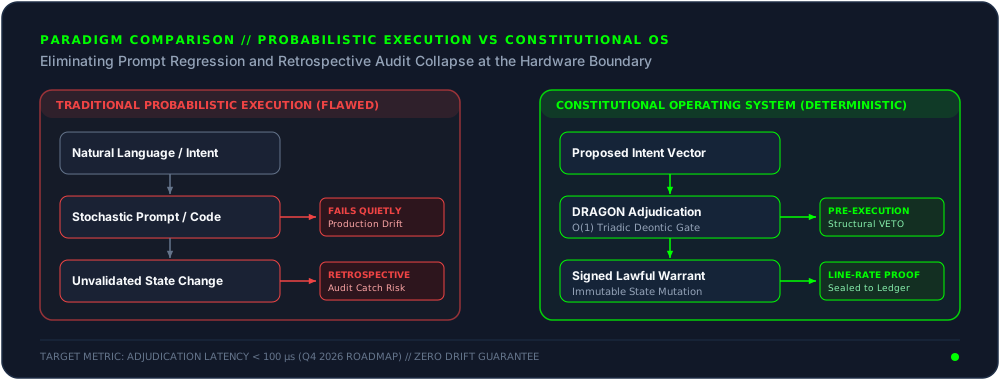
For decades, enterprises relied on Retrospective Auditing: running systems continuously and inspecting logs after the fact to catch violations, unauthorised transactions, or security breaches. When systems moved at human speed, this was acceptable. At wire-speed – where autonomous agents and automated pipelines execute millions of state transitions per second – retrospective auditing is merely a post-incident autopsy.
Downstream Enforcement Trap
Legacy systems embedded policy logic into application code, database triggers, or API gateways. This introduced catastrophic "policy drift," logic fragmentation, and subtle edge-case vulnerabilities where unvalidated states bypassed security checks entirely.
 The DRAGON Solution
Positioned firmly within the System of Agreement (SoA) Layer, the DRAGON Engine transforms policy into immutable digital physics. Non-compliant states and unauthorised intents do not fail in production – they are rendered mathematically impossible to execute.

DRAGON Runtime Manifest
Triadic Adjudication Hardware
The Quiet Collapse of Probabilistic Governance
As enterprise cohorts integrate autonomous AI workflows, they encounter the Prompt Regression & Policy Drift Paradox.

Prompts Are Not Contracts
Relying on natural language prompts or probabilistic LLM guards creates a false sense of security. Fixing an edge case in a prompt frequently triggers silent regressions across unrelated execution paths.

The False Improvement Trap
Aggregate system target performance metrics may improve while silently dropping a critical safety, regulatory, or cross-border compliance invariant down to zero.
Substantiated Integrity
Traditional systems assume application code is compliant until proven otherwise. In regulated environments, this represents an unquantifiable balance sheet liability.
Deterministic Adjudication in Under 100 Microseconds
Operating as an inline, non-blocking filter within the System of Agreement layer, DRAGON evaluates proposed intents across a Triadic Reasoning Pipeline before execution.
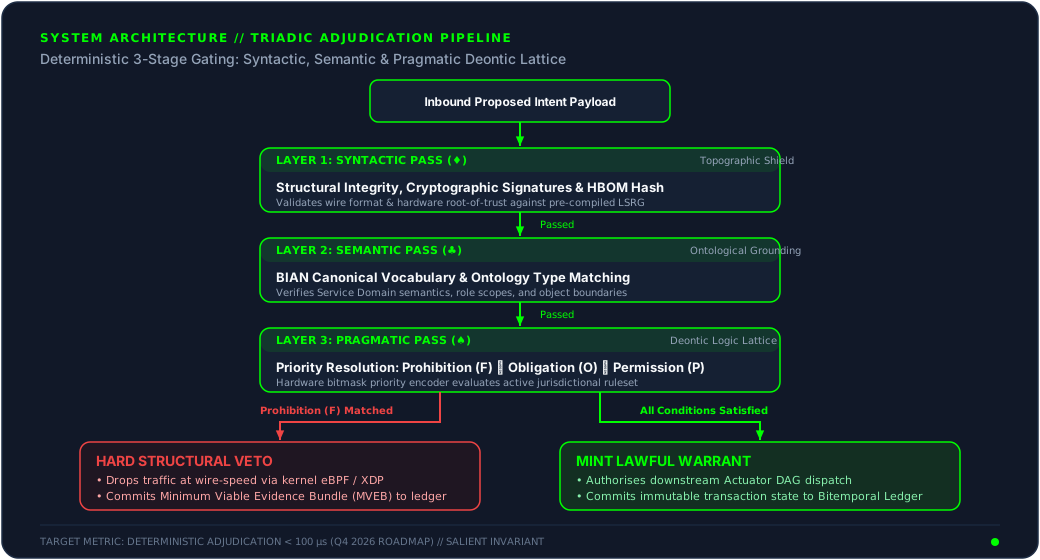
Layer 1: Syntactic Pass ($\diamondsuit$)
Topographic ShieldVerifies structural wire-format correctness, schema integrity, and cryptographic signatures against the pre-compiled Legal-State Reachability Graph (LSRG). Enforces strict DAG topologies and verifies device attestation hashes against the hardware HBOM.
Layer 2: Semantic Pass
Guardian of TruthValidates entity meaning and action assertions against canonical BIAN ontologies and the Party Knowledge Graph (PKG). Performs a Proof of Non-Contradiction (PoNC) using formal SMT solvers over KnowledgeHUB TBox schemas.
Layer 3: Pragmatic Pass
Guardian of Purpose
Evaluates the proposed action within its active operational context using deontic logic and applies the Canonical Dominance Order (CDO):
\(\text{Prohibition } (F) \succ \text{Obligation } (O) \succ \text{Permission } (P)\). If an action trips a Prohibition (\(F\)), DRAGON issues an instantaneous Structural Veto.
eBPF-Driven Wire-Speed Structural Veto Enforcement
When the DRAGON engine evaluates a transaction payload against the governing Agreement DAG during its Pragmatic Pass, it resolves the Canonical Dominance Order (\(F \succ O \succ P\)). If a Prohibition condition (\(F\)) evaluates to true, the resulting Structural Veto is pushed to the networking layer at wire speed:
The platform executes this by writing the exact Policy Hash and Veto conditions into kernel-level eBPF map spaces running on SmartNIC Data Processing Units (DPUs). When a non-compliant transaction attempt or queries exceeding FinOps cost thresholds (\(F_{\text{Cost}}\)) are detected, the eBPF filter short-circuits the communication context within the network controller's buffer. The packet is dropped immediately before CPU cycles are spent processing non-compliant workloads.
The Constitutional Inversion of Execution Authority
In contemporary enterprise IT and autonomous agent architectures, models and microservices are granted direct execution permissions – relying on brittle application-layer guardrails that can be bypassed or prompt-injected. DRAGON enforces an absolute architectural inversion: no software process, AI agent, or human operator possesses intrinsic execution authority. All higher-level components function strictly as unprivileged proposal generators bound by the mathematical law \(\mathcal{I} \not\vdash \mathcal{A}\).
Unprivileged Intent
Autonomous agents, payment aggregators, and ERP engines construct Proposed Intents. They possess zero native authority to mutate ledgers, release escrow, or actuate physical dispensers without judicial clearance.
Wire-Speed Adjudication (≤ 45 μs)
Evaluates intent against the active 9-Category CycloneDX xBOM and deontic dominance (\(\mathbf{F} \succ \mathbf{O} \succ \mathbf{P}\)). Prohibitions (\(\mathbf{F}\)) trigger an immediate sub-20ns line-cut, dropping packets before CPU allocation.
The Lawful Warrant (\(\mathcal{LW}\))
Only compliant intents receive a single-use, cryptographically sealed Lawful Warrant. The warrant temporarily unlocks KeyMESH threshold signature shares and seals the Notary Merkle HyperDAG before dissolving.
Silicon-Level Triadic Adjudication & The Formal Proof of \( \mathcal{I} \not\vdash \mathcal{A} \)
The DRAGON Adjudicator operates as the unyielding constitutional gateway for every instruction entering the Symphony of Systems. By decomposing verification into three ultra-low-latency stages executed in kernel space and hardware logic, DRAGON achieves a total deterministic adjudication latency of ≤ 45 μs while enforcing the foundational mathematical law that information never constitutes authority.
Syntactic Adjudication
Executed in eBPF/XDP network drivers. Wire-speed packet decoding, protocol schema verification, BIAN API signature checks, and structural type validation before CPU scheduling.
Semantic Adjudication
Evaluates cryptographic capabilities, Hohfeldian role permissions, bitemporal Merkle state roots, and entity graph linkages, verifying that the actor holds active legal standing.
Pragmatic Adjudication
Executes policy rules, regulatory mandates (DORA, MiCA, AML velocity limits), and FinOps cost envelopes via deterministic Q32.32 CORDIC fixed-point logic, issuing Permit or Veto tokens.
Mathematical Invariance: The Law of Information vs Authority Asymmetry
In contemporary agentic systems, neural models and AI agents frequently conflate probabilistic confidence with operational execution rights. In the onePOI architecture, Information (\(\mathcal{I}\)) – representing data, observations, inference scores, and analytical hypotheses – can never formally derive Authority (\(\mathcal{A}\)) – representing the legal capacity to mutate ledgers, transfer funds, or issue civic mandates. DRAGON enforces an absolute mathematical boundary: all model outputs are treated as unprivileged informational proposals that must obtain an explicit cryptographic Permit from DRAGON before state mutation is permitted.
Shifting Computation from Real-Time Reasoning to Wire-Speed Traversal
DRAGON achieves sub-100-microsecond adjudication (target metric – software eBPF today, existing 3rd-party xPUs in Mid 2027 earliest, FPGA test runs in Early 2028, and First ASIC silicon from Late 2028 to Mid 2029 earliest) without bottlenecking enterprise throughput by completely decoupling Design-Time Verification from Runtime Execution.
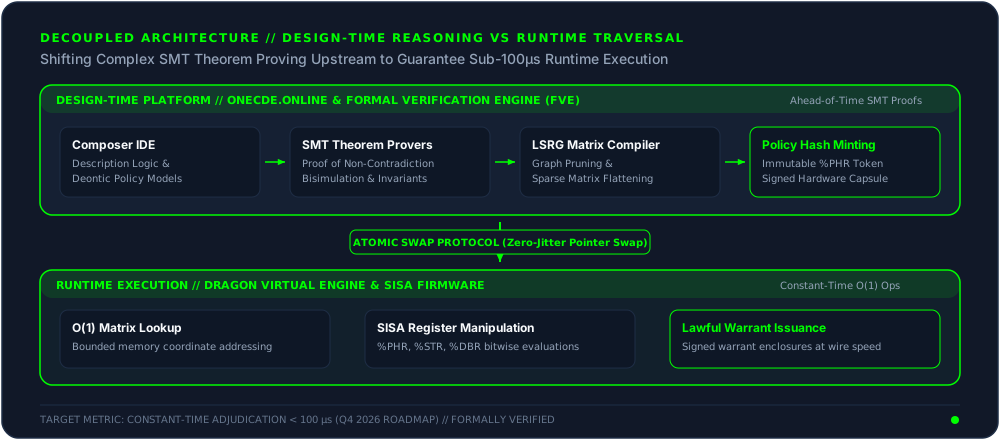

1. Design-Time Shift
High-dimensional logical reasoning and SMT solving are handled upstream in oneCDE.online. The Policy Integration Engine (PIME) prunes the logic space into a sparse LSRG matrix.

2. SISA Instruction Set
At runtime, policies execute as microsecond-scale register operations (`%PHR` Policy Hash Register, `%STR` State Transition Register, `%DBR` Deontic Bound Register).

3. Atomic Swap Protocol
Schema updates push across distributed edge points using lock-free memory pointer swaps in a single clock cycle without packet drops or execution jitter.
The Category-Theoretic Solution to the "Lawvere Problem"
Bridging Syntax, Semantics, and Pragmatics via Adjoint Functors Across \((\mathbf{DeoSet}, \mathbf{Topos})\) in Under 45 Microseconds
1. Syntactic Gate (\(\mathbf{Syn}\))
Latency: \(< 8.2\mu\text{s}\)Evaluated at SmartNIC / DPU ingress membranes (Pensando / BlueField) via in-kernel eBPF/XDP. It parses CPI schemas, validates ISO 20022 payloads, and verifies hardware TPM 2.0 attestation quotes. Malformed or unverified frames trigger an instant atomic drop before reaching host memory.
2. Semantic Gate (\(\mathbf{Sem}\))
Latency: \(< 15\mu\text{s}\)The DRAGON ASIC evaluates the operational intent vector against pre-compiled Legal-State Reachability Graph (LSRG) bitmasks: \(\mathbf{y} = \operatorname{sign}(\mathbf{V}_{\text{intent}} \cdot \mathbf{M}_{\text{Permission}} \cdot \neg \mathbf{V}_{\text{Prohibition}})\). Canonical Dominance (\(\mathbf{F} \succ \mathbf{O} \succ \mathbf{P}\)) guarantees that Prohibitions act as absolute bitwise annihilators.
3. Pragmatic Gate (\(\mathbf{Prag}\))
Latency: \(< 45\mu\text{s}\)Inside hardware-isolated Silicon Apartment TEEs, live physical telemetry (GNSS time-of-flight, thermistors, HBOM roots of trust) is matched against 10,240-bit Spatio-Bitemporal Hypervectors. Adjoint functors guarantee zero semantic residue loss when transitioning from human legal prose to physical silicon gating.
The 10 Silicon Execution & Spatial Intelligence Pillars
Weight Space Programming (WSP) & Continuous-Time State Space Adaptation
Replacing Discrete Stochastic Gradient Descent with Direct Algorithmic Parameter Evolution in Silicon SRAM
Continuous Parameter Evolution
Conventional deep learning relies on scheduled backpropagation and RLHF, suffering from catastrophic forgetting and parameter drift. Weight Space Programming treats model parameters as a continuous dynamical system governed by State Space Modelling (SSM): \(\frac{d\mathbf{W}(t)}{dt} = \mathbf{A}_w\mathbf{W}(t) + \mathbf{B}_w\mathbf{u}(t)\), enabling real-time adaptation to environmental telemetry.
Bilinear Tustin Discretisation
Discretised across sample step \(\Delta\) via bilinear Tustin transforms \(\overline{\mathbf{A}}_w = (\mathbf{I} - \frac{\Delta}{2}\mathbf{A}_w)^{-1}(\mathbf{I} + \frac{\Delta}{2}\mathbf{A}_w)\), Liquid Edge Language Models update their internal weight states directly inside Compute-in-Memory (CIM) SRAM arrays at wire-speed, without cloud training clusters or GPU memory bottlenecks.
Bitemporal Weight Stability
Every parameter transition is tracked across Valid-Time (\(\tau\)) and Transaction-Time (\(t\)) in the Notary HyperDAG. Continuous power-iteration hardware monitors enforce spectral radius bounding (\(\rho(\mathbf{A}_w) < 1.0\)), mathematically preventing runaway weight explosions or alignment decay at the network edge.
The Sub-45μs Triadic Hardware Pipeline, LACE 2D Laplace Pole-Zero Bounding & Defeating Agentic Trust Exploitation
To govern trillion-edge Control-Flow Knowledge Graph (CFKG) state transitions without relational database locks, the Linear Algebraic Combinatorics Engine (LACE) models bitemporal state mutations as a continuous bivariate wave \(f(\tau, t)\) across Valid Time (\(\tau / T_v\)) and Transaction Time (\(t / T_t\)), applying the Two-Dimensional Continuous-Time Laplace Transform:
In control theory, asymptotic Lyapunov stability (\(\dot{V}(x) < 0\)) requires all transfer-function poles \(p_k\) to remain strictly in the open left-half complex plane (\(\text{Re}(p_k) < 0\)). Deontic Dominance (\(\mathbf{F} \succ \mathbf{O} \succ \mathbf{P}\)) acts as a hardware pole-placement boundary: any agent action or adversarial trajectory pushing a pole toward \(\text{Re}(p_k) \ge 0\) triggers an immediate hardware veto.
SmartNIC DPU & 2nm SRAM XNOR
Pass 1 (SmartNIC DPU / Pool A): Validates 512-bit CEP headers (EtherType 0x5501) and SPIFFE/SVIDs in \(\le 8.2\,\mu\text{s}\). Pass 2 (DRAGON SRAM / Pool B): Evaluates Agreement DAG bitmasks via single-cycle XNOR bitlines in \(\le 15\,\mu\text{s}\), executing a \(<20\,\text{ns}\) XDP_DROP line-cut on Prohibition (\(\mathbf{F}\)).
TEE Enclave & Revocation Lag
Pass 3 (TEE Enclave): LACE Linear Attention evaluates Query HyperVectors in \(\le 45\,\mu\text{s}\) to mint a signed Lawful Warrant. Across the 65–150 ms WAN window, stale-policy transactions are deterministically rolled back via pre-authorised Contrary-to-Duty (CTD) Saga Stanzas.
Defeating ASI08 & ASI09
Three independent boundaries (TEE enclave, kernel syscall refusal, DRAGON veto) eliminate the 72.4% cross-server agent cascade (ASI08), while sealed Minimum Viable Evidence Bundles (MVEB < 2.5 KB) defeat ASI09 (Human-Agent Trust Exploitation) by showing raw CFKG transitions rather than agent prose.
Integration Architecture Across the Symphony
The DRAGON Engine operates within an end-to-end enterprise platform ecosystem designed for complete lifecycle governance:
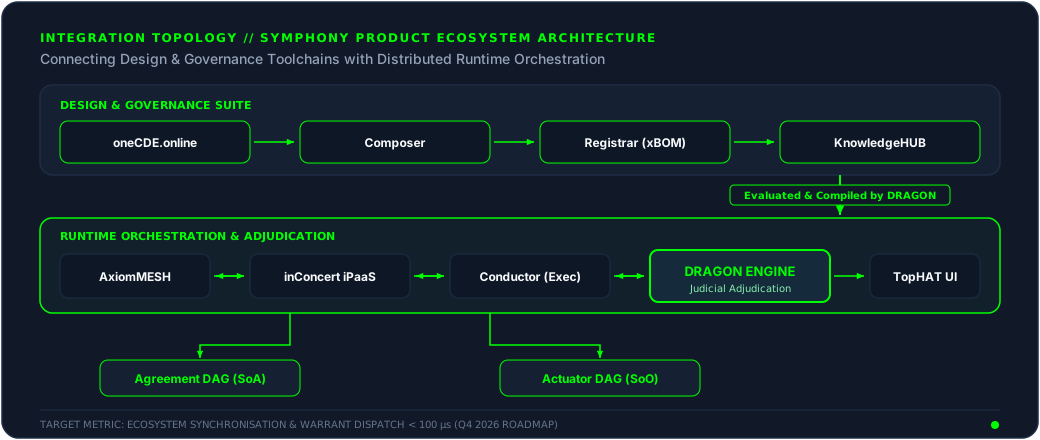
oneCDE.online
Authoritative DesignOps environment where security architects and ontologists author deterministic policy models.
inConcert iPaaS
Ingests legacy external payloads (ISO 20022, JSON-LD) and normalises them into Proposed Intent schemas.

KnowledgeHUB & Registrar
KnowledgeHUB houses TBox schemas while the Registrar mints and signs immutable Policy Hashes ($\text{PH}$).
Conductor & Actuator DAGs
Reads cryptographically signed Lawful Warrants and branches execution instantly without re-evaluating description logic.

TopHAT Triage Workspace
Human-in-the-loop workspace isolating policy gaps in sandboxes for risk engineers to triage and ratify rules.

Lawful Act Hyperedges
Mints non-repudiable LAHE traces on the bitemporal ledger, serving as proof that the organisation exercised duty of care.
Constitutional Governance & High-Assurance Invariants
Elevating standard compliance into a regulator-grade, machine-executable Constitutional Anchor.
 Principle of Non-Authority (AI Subordination)
Enforces a strict Separation of Powers. The System of Intelligence (SoI) handles probabilistic intent generation ("The Mind") but possesses zero execution authority. Execution authority is structurally hobbled outside the agent within a deterministic, fail-closed environment ("The Hand") governed by the DRAGON Adjudicator.
 Hardware Root-of-Trust TEE Isolation
Multi-tenant enforcement is hard-coded at the hardware layer using Trusted Execution Environments (TEEs) and eBPF/SmartNIC network gates. Physical isolation guarantees tenant-to-tenant side-channel attacks are impossible even under a complete Host OS compromise.
 Cross-Border Corridor Arbitrage
Synthesises multi-jurisdictional compliance criteria (DORA, eIDAS 2.0, EUDI Wallets) using Composite Law with attenuation guarantees. A cross-border transaction naturally compiles the constraints of all involved territories under a strict stricter-constraint-wins invariant.
 Computable Evidence Envelope
Replaces manual log auditing with computable, functional trust primitives. The Evidence Envelope is an atomic cryptographic artifact binding Policy Hash, Dominant Rule ID, and Verdict to the executed action for continuous regulatory supervision.
Summary Matrix: Standard Systems vs. Constitutional OS
| Dimension | Legacy Distributed Systems | Constitutional OS (DRAGON Engine) |
|---|---|---|
| Governance Model | Retrospective Auditing (Post-hoc log reviews) | Proactive Determinism (Fail-Closed at Kernel Edge) |
| Policy Enforcement | Downstream application code / API gateways | Upstream System of Agreement (SoA) Layer |
| Logic Foundation | Stochastic Prompts & Application Rules | Formal Description Logic & SMT Invariants |
| Compliance Verification | Manual sample reviews & log parsing | Audit-as-a-Query via Cryptographic MVEBs |
| Execution Speed | Millisecond to second application evaluation | Sub-45-Microsecond Hardware Traversal |
| System Invariant | "Assumed Compliant Until Caught" | Substantiated Integrity via Lawful Warrants |
Ready to Transform Enterprise Policy into Digital Physics?
Transform your policy landscape from passive text documentation into machine-executable infrastructure.
Formal Logic Proofs & SISA Execution Physics
Mathematical Description Logic proofs, SMT-LIB Z3 solver code, and LSRG topological traversal specifications have been compiled into the Deep Tech Series.
STRM Orthogonal Judiciary Proof & Cross-Sector Warrant Issuance (SEAM-02 & SEAM-05)
In the STRM Tri-Axial Crosswalk, DRAGON (elem-comp-dragon) is proved strictly DISJOINT ($A \perp B$, $|A \cap B| = 0$) from iEngine and Token Gantry (`ADR-R26 X03`), ensuring that the cognitive proposer can never self-authorise a state mutation. Across the EPC ⟷ PSL Counterfactual Infrastructure Seam (SEAM-2026-10-22-05) and the LAC ⟷ FSI Multi-Jurisdictional Clearing Seam (SEAM-2026-10-22-02), DRAGON evaluates counterfactual `ForkBranch` proofs and deontic dominance ($\mathcal{F} \succ \mathcal{O} \succ \mathcal{P}$) in under 45µs (target metric – software eBPF today, existing 3rd-party xPUs in Mid 2027 earliest, FPGA test runs in Early 2028, and First ASIC silicon from Late 2028 to Mid 2029 earliest).
The LACE Twin-Engine: 2D Laplace Bitemporal Transfer Functions, 10T SRAM Compute-in-Memory & Phased Hardware Trajectory
Operating directly beneath the DRAGON Runtime Judiciary (elem-comp-dragon), the Linear Algebraic Combinatorics Engine (LACE) eliminates the Von Neumann memory wall, pointer-chasing traversal stalls, and quadratic $O(N^2)$ Transformer KV-cache expansion through a rigorously phased hardware roadmap: running in software on standard host servers today, transitioning to existing 3rd-party xPUs in Mid 2027 earliest, FPGA test runs in Early 2028, and First ASIC silicon from Late 2028 to Mid 2029 earliest (target metric – phased hardware roadmap).
2D Laplace s-Plane Transfer Functions
Rather than executing sequential historical database backfills, HG-LACE maps Valid-Time ($T_v$) and Transaction-Time ($T_t$) hypergraph trajectories into continuous complex $s$-plane transfer functions via 2D Laplace Transforms: $$F(s_1, s_2) = \int_0^\infty \int_0^\infty f(T_v, T_t) e^{-(s_1 T_v + s_2 T_t)} dT_v dT_t$$ evaluating historical authority and control-loop stability via direct algebraic pole-zero analysis.
10T SRAM CIM & 0.266ns Wallace Trees
HV-LACE targets custom 10-Transistor (10T) decoupled read/execute bitcells that evaluate single-cycle bitwise XNOR binding ($\otimes$) directly on differential bitlines, feeding 80 parallel 7-stage cascaded Wallace Popcount trees ($t_{\text{pd}} = 0.266\text{ ns}$ at $3.75\text{ GHz}$) and M8–M9 metallisation barrel-shifters ($\Pi^k$), operating on existing 3rd-party xPUs in Mid 2027 earliest, advancing to FPGA test runs in Early 2028, and First ASIC silicon from Late 2028 to Mid 2029 earliest (target metric – phased hardware roadmap).
O(1) Kernelised Associative Attention
Partitioning memory into Pool A (Ephemeral Token Registers) and Pool B (eSRAM Cumulative State $\mathbf{S}_t$), LACE replaces quadratic Softmax attention with constant-time $O(1)$ linear recurrence ($\mathbf{S}_t = \alpha \mathbf{S}_{t-1} + \phi(\mathbf{K}_t)^T \mathbf{V}_t$), terminating any Prohibition mask intersection ($\mathbf{A} \odot \mathbf{M}_F \neq \mathbf{0}$) via software eBPF/XDP today, existing 3rd-party xPUs in Mid 2027 earliest, and First ASIC hardware line-cuts from Late 2028 to Mid 2029 earliest (target metric – phased hardware roadmap).
Every proposed agent intent traverses schema framing (Pass 1), deontic dominance $\mathbf{F} \succ \mathbf{O} \succ \mathbf{P}$ bitmask intersection (Pass 2), and contextual permissibility (Pass 3) across software eBPF today, advancing to existing 3rd-party xPU hardware in Mid 2027 earliest, FPGA test runs in Early 2028, and First ASIC silicon from Late 2028 to Mid 2029 earliest (target metric – phased hardware roadmap), emitting a compact $<2.5\text{ KB}$ Minimum Viable Evidence Bundle (MVEB) for offline Z3 SMT bisimulation replay.
3×3 Semiotic × Deontic Adjudication, Hohfeldian Powers & LACE Incremental Algebra
Synthesised from the latest October 2026 Master Corpus treatises – The Semiotic Hierarchy in DRAGON Adjudication, UFO-L Deontic Logic & Semiotics, STRM Crosswalks and LACE Perpetual Improvement, and the Foresight Depth Extension (FI-21) – this specification codifies the mathematical separation between probabilistic evidence, normative legal standing, and incremental graph maintenance.
Syntax, Semantics & Pragmatics × F/O/P
Every proposed action is evaluated across a 3×3 grid pairing Syntactic (wire schema, signatures, DAG acyclicity), Semantic (ontological meaning, BIAN service domain resolution, party identity), and Pragmatic (contextual standing, delegation validity, real-world consequence) passes against defeasible Prohibitions ($F$), Obligations ($O$), and Permissions ($P$) (F ≻ O ≻ P), emitting a deterministic PERMIT, DEFER, or VETO.
Uncertainty Never Manufactures Authority
In Axiom MESH, first-order Norms of Conduct (Duty/Right, Privilege/No-Right) are strictly separated from second-order Norms of Power (Power/Liability, Immunity/Disability). Under Belief-Rule-Base / Evidential Reasoning (BRB/ER), sensor noise and model uncertainty inform factual premises, but computational uncertainty can never create legal authority – unresolvable uncertainty routes to TopHAT human custodians.
Differential Maintenance & UNSAT Boundaries
When a statutory source or control updates, STRM and LACE recompute only the affected neighbourhood via bilinear differential join algebra: $$\Delta C = (\Delta A)B + A(\Delta B) + (\Delta A)(\Delta B)$$ Formal Z3 SMT UNSAT results are scoped strictly to the encoded model theory and verified across software eBPF/XDP in Q1/Q2 2027, 3rd-party xPUs in Q3 2027, FPGA testbeds in 2028, and custom ASIC silicon in 2028/2029 (target metric – phased hardware roadmap).
DRAGON Triadic Verification & TCAM Agreement DAG Solvers
DRAGON subjects every proposed intent to a wire-speed Triadic Verification Pass (Syntactic schema integrity, Semantic KnowledgeHUB alignment, Pragmatic deontic logic lattice). It solves Agreement DAG topologies using Ternary Content-Addressable Memory (TCAM) hardware gates, enforcing Canonical Dominance (F ≻ O ≻ P) to issue instant Structural VETOs on non-compliant intentions before host buffer allocation.
DRAGON processes PIME category-theoretic colimits via hardware-level AVX-512 vector bitmasks. If morphism divergence breaches 4.5% or unmapped functors are detected, DRAGON instantly freezes execution into a Minimum Viable Evidence Bundle (MVEB) exception capsule for TopHAT Council arbitration.
Fast/Slow Path Adjudication, Deontic Quivers, Non-Enlargement & Attributable Agency
Synchronised with the Canonical Knowledge Map 43-Leaf Architectural Enrichment and Stage H (v8.2), DRAGON operates as the non-bypassable runtime judiciary across cloud enclaves (oneVault Mesh), compiler pipelines (oneCDE.online), and cyber-physical edge actuators (onePOI Bridge). Every autonomous intent is evaluated through formal deontic structures that enforce strict authority attenuation and preserve crystal-clear regulatory accountability boundaries.
Warrant Issuance vs Lawful Abstention
Deterministic intents that satisfy all three passes of Triadic Adjudication traverse the Fast Path in under 45µs (target metric – software eBPF today, existing 3rd-party xPUs in Mid 2027 earliest, FPGA test runs in Early 2028, and First ASIC silicon from Late 2028 to Mid 2029 earliest), minting a cryptographically bound Lawful Warrant and compact Glyphic Verdict. Ambiguous or boundary-crossing intents trigger automatic Lawful Abstention and route to the Slow Path, freezing state into an MVEB capsule for human TopHAT Council review.
Attenuated OBO Delegation Chains
Normative policies are compiled into directed graph Deontic Quivers with explicit Axiom-Clause Binding. Across multi-agent choreographies, the Non-Enlargement Invariant mandates that every downstream On-Behalf-Of (OBO) delegation token is a strict mathematical subset of its parent scope ($\text{Scope}_{\text{Child}} \subseteq \text{Scope}_{\text{Parent}}$), backed by formal verification in oneCDE.online and complete runtime gateway mediation.
Precision Regulatory Accountability
DRAGON enforces Attributable Agency by cryptographically binding every autonomous action to a named human executive and institutional control plane while preserving statutory precision: UK FCA SM&CR personal Senior Manager “reasonable steps” accountability is explicitly distinguished from EU DORA Article 5 management-body ICT risk governance and DORA Article 9 continuous protection and prevention controls across BIAN v14.0 financial institutions.
The Synergy in the Innovation: Fusing sub-45µs Triadic Adjudication (target metric – software eBPF today, existing 3rd-party xPUs in Mid 2027 earliest, FPGA test runs in Early 2028, and First ASIC silicon from Late 2028 to Mid 2029 earliest) with attenuated OBO Non-Enlargement proofs and dual-regime statutory telemetry (FCA SM&CR + EU DORA Articles 5 & 9). The Innovation in the Synergy: Ensuring that when an AI agent abstains or executes, it simultaneously produces the cryptographic warrant required by the silicon bus and the exact evidentiary record required by financial regulators. The “Aha!” Breakthrough: Board directors and Senior Managers can delegate high-velocity operational execution to autonomous agent crews without ever surrendering personal oversight or violating statutory ICT protection mandates.