Engineered for Institutional Margins.
Adopted for Human Sovereignty.
Every capability across the Salient Innovation Set delivers an immediate, symmetrical return: radical margin recovery for the enterprise tenant, paired with frictionless dignity and absolute cryptographic safety for the citizen.
How the Tenant Expands Margins
Transforming operating models from defensive cost centres into agile, shared revenue engines through multi-tenant pooling and mathematical compliance.
-

CapEx Pooling & No Single-Tenant Hardware
POI Appliances run white-label on co-funded premises. Reach 50 commercial catchments without funding 50 proprietary branch builds.
-

Zero Interchange & Flat-Fee Clearing
Instant Account-to-Account rails (SEPA Instant / PayShap) bypass 1.5–3.5% card scheme tolls with predictable, flat sub-cent clearing fees.
-

Compliance by Construction
Agreement DAGs enforce statutory mandates at wire speed; non-compliant states cannot execute, eliminating retrospective audit penalties.
-
Accelerated Partner Onboarding
Pre-verified BIAN and ArchiMate capability components compress multi-firm integration cycles from quarters to days.
Why the Customer Loves Using It
Delivering sovereign dignity and verifiable security where users never surrender control over their identity, consent, or funds.
-

Nothing Stored to Steal
Credentials remain in the user's oneWallet. A breach of a merchant's server reveals zero identity records, protecting citizens completely.
-

One Pattern, Everywhere
The same intuitive tap-and-confirm interaction works seamlessly at a high-street kiosk, transit hub, EV charger, or smartphone.
-

Delegated Authority, Never Escalated
Autonomous AI agents carry single-use, bounded warrants; an agent checking information cannot escalate its authority to transfer money.
-
Payments That Do Not Fail
When a payment network degrades, the transaction reroutes with authentication preserved – zero declines, zero repeated entries.
Quiver Runtime Manifest
Hardware-Anchored Execution Engine
The Quiver Runtime: Transforming Policy into Physics
The translation of human legal intent into silicon-enforced physics occurs through a rigorous Architectural Pipeline that bridges the gap between high-level Agreement DAGs and tactical Actuator DAGs. This process ensures that no infrastructure transition or autonomous action can bypass the constitutional constraints defined by the Axiom MESH.
The onePOI.online Constitutional Operating System (COS) fundamentally re-engineers this paradigm through the Quiver Runtime. A Quiver is not merely an abstract category-theoretic diagram of relational laws; it is a high-assurance execution engine and capability set that transforms abstract corporate governance into mathematical, hardware-anchored instruction sets. It is the definitive library of "Lawful Transitions" that your enterprise system is architecturally capable of executing.
Architectural Pipeline Execution Stages
Compilation & Transition: From Quiver to DAG (Composition Mechanics)
Full Agreement or Actuator DAGs are not monolithic structures but are assembled through **Categorical Composition** of modular Quiver components:
- ▪ Category-Theoretic Colimits: Modular Quivers are composed into a unified DAG via colimits (specifically pushouts). This process "glues" overlapping nodes (vertices) and edges while preserving the formal properties (e.g. acyclicity) required by the **Formal Verification Engine (FVE)**.
- ▪ Algebraic Tensor Products: For multi-party or multi-tenant scenarios (e.g. a cross-border trade involving different Jurisdictional Axioms), Quivers are combined using algebraic tensor products. This allows the system to represent the "interaction space" of two independent sets of constraints without losing the individual identity of each rule set.
- ▪ Deterministic CFKG Merge: During final compilation by the Policy Integration & Mapping Engine (PIME), these modular components undergo a Deterministic Control Flow Knowledge Graph (CFKG) Merge. This ensures that the control flow (what is allowed) and signal semantics (how it is executed) are ordered using high-precision timestamps (PTP), preventing race conditions during transition.
Structure of the DAG Catalogue (The Semantic Anchor)
Human legal intent is bound to its formal Quiver counterpart through a **Triadic Binding** process to ensure absolute auditability:
- ▪ Semantic Anchors: Natural language clauses are mapped to precise nodes in a unified registry via Ontological Snapping. This process ensures that a term like "payment terms" in a contract matches the exact mathematical definition in the **KnowledgeHUB**.
- ▪ Cryptographic Metadata Links: Every Quiver component contains a metadata link (a Policy Hash) that ties the natural language text to its formal graph structure. This link is captured in the Minimum Viable Evidence Bundle (MVEB), allowing auditors to "see" the exact prose that authorised a specific digital act.
-
▪
Reverse Translation & Bitemporal Semantics: Updates are managed through Bitemporal Semantics (
V_tfor Valid-Time vs.T_tfor Transaction-Time). For auditability, the system performs a reverse translation of the machine-readable DAG back into a human-auditable Smart Legal Contract (SLC) layout, ensuring the "spirit" and "letter" of the law remain in perfect bisimulation.
Deontic Logic & Edge Adjudication (The Scale of a Quiver)
A Quiver is a highly flexible unit of logic, and its scale is determined by its **Deontic Functional Boundary**:
- ▪ Atomic Quivers: Can be as small as a single conditional statement or "Strophe" (e.g. specific risk-threshold checks).
- ▪ Modular Quivers (Stanzas): Typically correspond to a single, reusable legal clause or sub-policy, such as "Payment Terms," "KYC Verification," or "GDPR Right to Erasure."
- ▪ Composite Quivers: Pre-verified sets of modular Quivers can be bundled into "Capability Sets" or "Packaged Business Capabilities (PBCs)," representing a full high-level business process like "Corporate Onboarding."
-
▪
Dominance Ordering & Veto: Deontic states are enforced at the hardware level through Dominance Ordering (
F ≻ O ≻ P). During a transition, the hardware-level **SpMV engine** walks the LSRG. If an edge is prohibited, the DRAGON engine issues a **Structural VETO** and generates a **Proof of Contradiction** artefact, physically blocking the transition at the **DRAGON ASIC** layer.
Actuator DAG Stanzas (Actuation Layer Alignment)
The alignment between the legal "what" (Agreement) and the technical "how" (Actuator) is guaranteed through **Architectural Decoupling**:
- ▪ Direct Mapping via PIME: A single "Agreement Clause Quiver" (e.g. "Charge Customer") maps directly to a corresponding "Actuator Step Quiver" (e.g. "Initiate ISO 20022 Payment") via the **Policy Integration & Mapping Engine (PIME)**. PIME **assembles and compiles** these modular Quivers into a final, hardware-addressable **LSRG**.
- ▪ The Lawful Warrant Guarantee: Alignment is guaranteed because Actuators are "authority-poor" and architecturally paralysed. An Actuator Quiver *cannot* move a single bit of value until it receives a **Lawful Warrant** from the DRAGON engine, which is only issued if the state transition is explicitly permitted by the Agreement DAG. This "Three-Tiered Governance Architecture" ensures a **Structural Separation of Powers**.
- ▪ Interoperability: Actuator Stanzas use a normalisation layer that maps raw inputs into uniform structures aligned with **BIAN** and **ISO 20022** data domains to drive legacy mainframes, cloud APIs, or AI agents.
Silicon Binding & TEE Enforcement
The Constitutional Operating System (COS) anchors governance to physical hardware:
- ▪ Hardware Root-of-Trust: Policy hashes (PH) and xBOM Fusion Manifests are cryptographically bound to the hardware substrate. Rule evaluation is distributed to the edge via eBPF membranes and DRAGON ASICs, ensuring that the "Law is Physics" at the nanosecond level.
- ▪ Multi-Tenancy (TEE Hardware-Isolated Enclaves): In multi-tenant environments, boundaries are maintained by localised enforcement. Shared Actuator DAGs can be executed, but the DRAGON engine evaluates each intent against the specific tenant's **L4 Axioms** and the global **L1/L2 Platform Constitution**, ensuring isolation within the TEE.
The system operates on a strict, hardware-enforced "Fail-Closed by Constitution" posture. If a software artefact or proposed transaction lacks a validated, signed Policy Hash (PH) aligned with the active Axiom MESH, it is axiomatically blocked from production at the silicon gate.
The Technical Specification At A Glance
| Component | Architecture Runtime Function | Definitive Governance Role |
|---|---|---|
| Quiver | Foundational Grammar | Defines the syntactically valid "action space". |
| Capability Set | Packaged Business Capabilities | Orchestrates tactical RunBooks into strategic enterprise workflows. |
| SBOM Topology | Software Provenance | Cryptographically binds execution code to the hardware substrate for cATO. |
| Actuator DAG | Universal Infrastructure Adapter | Translates the "Law" (Agreement DAG) into immediate digital or physical motion. |
Instant Policy Propagation & Authority Revocation
Quiver manages version changes for the rules of the business. When a company rule or compliance law is updated, Quiver sends the changes to all devices and systems instantly, deleting older rules immediately.
This ensures that no device or terminal continues to run under outdated instructions, preventing security lapses.
Operational Threat Response & Real-Time Risk Adjustments
Quiver minimizes compliance risks by enabling sub-millisecond policy rotations. When threat scores drift or regulations change, organisations must retract old permissions immediately under DORA frameworks.
It publishes updated policy hashes globally, guaranteeing that edge nodes, POS systems, and AI models synchronise their active compliance filters in real-time.
Continuous Threat Response (DORA)
Ensures security updates and threat mitigations propagate to edge nodes instantly.

Instant Authority Revocation
Retracts compromised keys or outdated permissions in sub-milliseconds.
Orchestration & Symphony – Integration
As the versioning engine in the System of Agreement (SoA), Quiver controls policy lifecycles. It interfaces with the Symphony – layers:
Hash Rotation
Re-mints Policy Hashes and registers updates in the central Registrar.
DRAGON Invalidation
Forces the adjudication engine to reject warrants based on stale policy hashes.
Bitemporal Sync
Coordinates with the ledger to ensure version lifecycles are timeline-accurate.
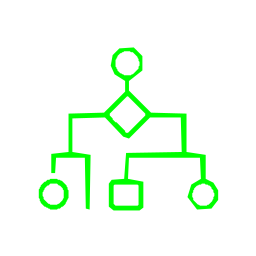
Atomic Map Versioning & Cryptographic Revocations
Atomic Map Versioning & Cryptographic Revocations
Atomic Map Versioning & Cryptographic Revocations Details
Uses Atomic Map Updates to rotate hashes without interrupting active transaction streams, sending invalidation signals to enclaves globally.
SmartNIC eBPF & Hardware Root-of-Trust
SmartNIC eBPF packet filter specifications, HBOM measured boot attestations, and Hardware Root-of-Trust theorems have been compiled into the Deep Tech Series.