Co-Authoring Law-as-Code Without Translation Drift
oneCDE.online acts as a shared constitutional workbench where legal counsel, compliance officers, and software engineers co-author executable commercial agreements and run formal test simulations side by side before release.
Instead of handing a PDF policy over a wall to developers months before launch, both disciplines validate the exact same rulebook – guaranteeing the code deployed at runtime matches legal intent word for word.
Architectural Taxonomy & Industry Alignment
Aligned with BIAN (Banking Industry Architecture Network) service domains, SABSA security attributes, and Gartner-defined Cloud Development Environment (CDE) standards, oneCDE.online normalises polyglot software development into deterministic, policy-bound assets:
BIAN Alignment
Maps business capability boundaries and semantic agreements to discrete Business Service Operations (e.g. Party Agreement, Payment Execution, Regulatory Compliance Verification), ensuring native banking interoperability across tenant fleets.
SABSA Assurance
Implements multi-tier operational trust by embedding contextual, non-derogable security attributes and trace matrices directly into the developer workflow, creating unbroken provenance from business driver to execution stanza.
Zero Ledger Contamination
Protects production records through air-gapped simulation planes, ensuring experimental code and test state never impact the live Bitemporal Hypergraph Ledger or live payment clearing networks.
Executive & Architectural Alignment
Eliminate Legal Translation Risk with Compile-Time Policy Enforcement
Traditional software development requires legal teams to review static text requirements, leaving software engineers to independently interpret compliance rules in code. This creates a dangerous “interpretation gap” that leads to regulatory fines and audit failures.
oneCDE.online provides an interactive Law-as-Code workspace where legal and compliance teams co-author contracts alongside developers. Rules are parsed into typed Deontic Primitives (O for Obligation, P for Permission, F for Prohibition). Our Z3 SMT solver validates every rule against constitutional axioms before compilation, making non-compliant software builds mathematically impossible to deploy.
Zero-Trust Runtime Isolation with Air-Gapped Simulation Planes
Testing autonomous agents, AI copilots, and smart contracts in staging environments often risks leaking state or triggering unintended micro-transactions on production rails.
oneCDE.online isolates all simulation subgraphs inside hardware-attested Simulation Planes. Every simulation payload carries a non-derogable Simulation Primitive Identifier. The DRAGON kernel enforces zero-trust boundary rules at the silicon level, guaranteeing that test scenarios can never write to the production System of Record (SoR) or execute live payment flows (FedNow, SEPA Instant, ISO 20022).
Polyglot Freedom, Uniform WASM Execution
Enterprise development teams use diverse tech stacks – Rust, Go, Python, TypeScript, Java, and C++. Standardising security and compliance controls across disparate languages is notoriously difficult.
Build in the language your team knows best. oneCDE.online compiles code from Rust, Python, Java, TypeScript, C/C++, and .NET into unified WebAssembly (WASM) bytecode primitives. Supported by Living RASP (eBPF-based Control Flow Integrity), your application code runs with target sub-millisecond efficiency across edge TEE enclaves, cloud microservices, and POS appliances.
oneCDE Runtime Manifest
Commercial Edge Execution Memory
The Agentic Cloud Development Environment (CDE): Architecture Framework
The Agentic CDE (oneCDE) establishes a continuous, silicon-enforced development cycle where software authoring, formal verification, and runtime attestation merge into an automated lifecycle.
Within oneCDE, software creation transitions from unmonitored human programming to a mathematically verified constitutional cycle governed by the Silicon Judiciary, ensuring complete compliance before code is deployed to staging or edge appliances.
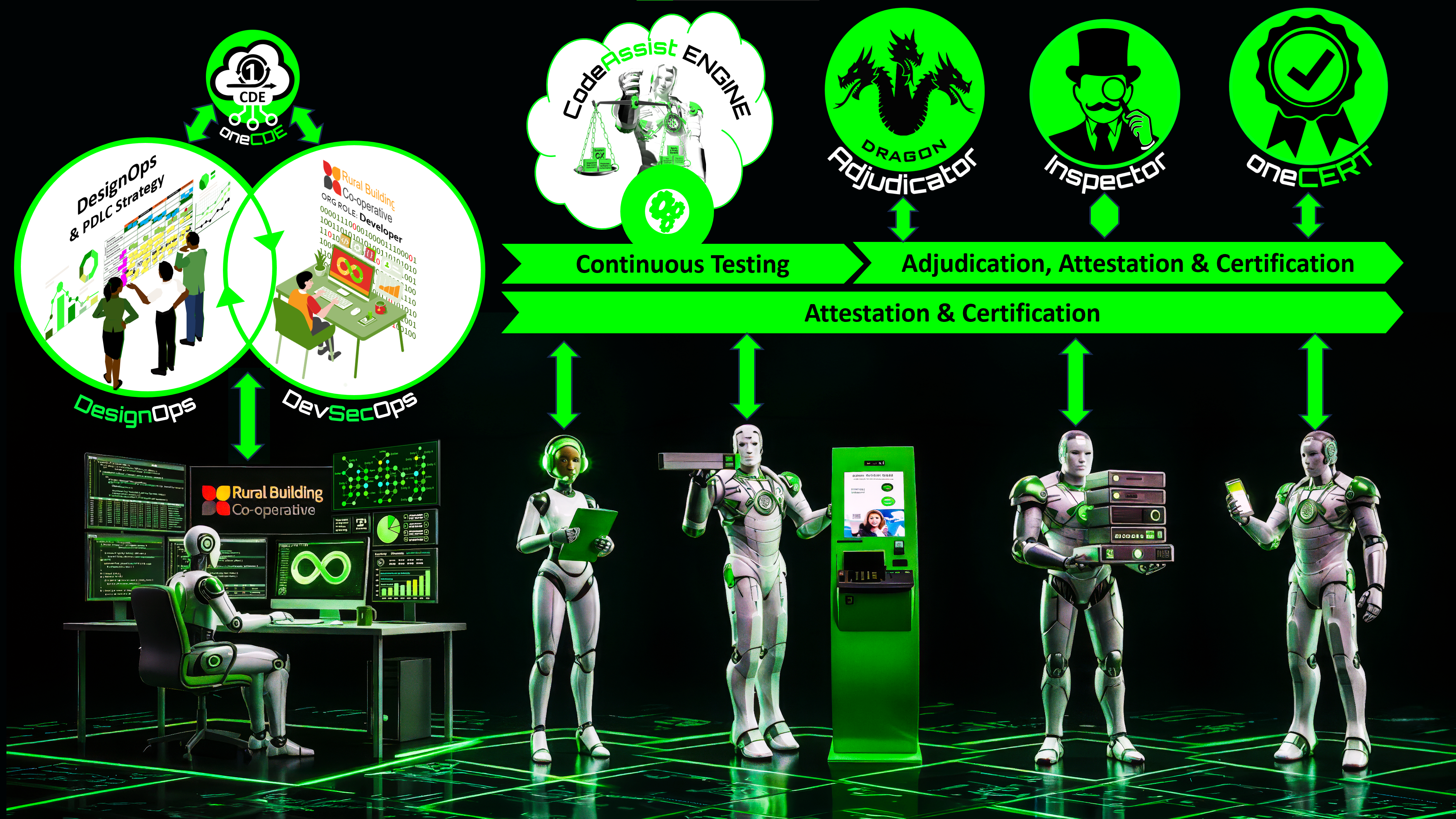
1. The Design & Development Cradle
I. DesignOps & PDLC Strategy
Within the DesignOps boundary, product lifecycles and enterprise constraints are modelled via a structured Product Development Lifecycle (PDLC) strategy. Rather than creating free-form blueprints, tenant cohorts plan system capabilities against pre-existing structural definitions, mapping cross-sector functionalities directly to global organisational ontologies before code authoring begins.
II. DevSecOps & The Collaborative Loop
Within the DevSecOps operational boundary, software engineers interface with local development terminals to feed code logic directly into the automated pipeline. A continuous validation loop connects DesignOps and DevSecOps, verifying that human creative intent matches the baseline architectural patterns approved during the design phase.
III. Governed Tenant Workstations
Tenant cohorts operate within dedicated, hardware-anchored engineering workspaces. Real-time telemetry surfaces code syntax trees, live data flow networks, and the foundational loop of continuous integration, ensuring that tenant-specific development remains securely bounded by platform root security parameters.
IV. Air-Gapped Counterfactual Governance via Simulation AI
To prevent machine learning models or testing processes from introducing policy instability or unexpected state updates into production environments, oneCDE implements air-gapped counterfactual governance. When a Graph Data Science (GDS) model runs scenarios to evaluate regulatory rewrites, every generated subgraph is sealed into an isolated Simulation Plane tagged with a non-derogable Simulation Primitive Identifier. The DRAGON kernel strictly prohibits any simulation-tagged node from writing to the production System of Record (SoR) or triggering live payment pathways.
2. Automated Assistance & Verification Flights
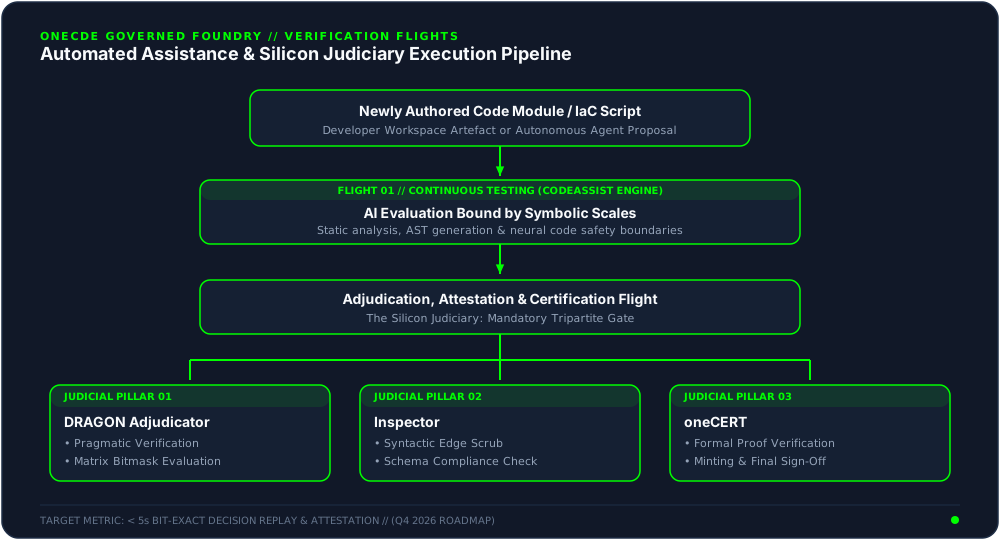
As code artefacts exit the developer workspace, they enter a performance-stratified processing pipeline divided into automated assistance and verification flights:
I. The CodeAssist Engine
The initial verification flight executes Continuous Testing driven by the cloud-based CodeAssist Engine. The engine balances neural code generation (probabilistic AI) with symbolic logic constraints. When an AI copilot or engineer introduces code or infrastructure scripts, the engine evaluates the payload against active rule structures to detect errors, vulnerabilities, and architectural deficiencies prior to compilation.
3. The Silicon Judiciary (Adjudication, Attestation & Certification)
Once a code module completes testing, it passes into the Silicon Judiciary flight of the TRS-MS, running un-bypassable checks driven by three primary platform authorities:
I. The DRAGON Adjudicator
The DRAGON Adjudicator executes the pragmatic pass of system policy evaluation, cross-referencing transaction state against active multi-tenant agreements. By evaluating rules through register-level vector bitmasks, DRAGON eliminates runtime latency and applies canonical dominance ordering to prevent illegal state transitions.
II. The Inspector
The Inspector agent executes edge-native syntactic sweeps and structural payload isolation, checking code modifications against exact regex rules and data schemas to catch input validation anomalies and protocol errors at wire-speed before host operating system resources can be affected.
III. oneCERT Regulatory Sandbox
The final validation node is oneCERT, functioning as the platform's jurisdictional regulatory sandbox. It emulates multi-tenant POI, POS, branch kiosk, and real-time payment rail environments (ISO 20022, SEPA Instant, FedNow). Once DRAGON and the Inspector prove complete policy adherence, oneCERT mints an immutable verification token.
IV. Polyglot Execution & WASM Runtime Engine
The oneCDE runtime supports polyglot code compilation across WebAssembly (WASM), Rust, Python, Java, TypeScript, C/C++, and .NET. Governance stanzas authored in any supported language are compiled into deterministic WebAssembly Bytecode primitives, enabling unified, zero-overhead execution across edge TEE enclaves, cloud microservices, and POS appliances.
4. Horizontal Platform Attestation (The Down-Stack Infrastructure)
The Attestation & Certification data highway links cloud development engines directly to physical hardware form factors, providing real-time telemetry and validation across four specialised edge deployment domains:
Analytics Node
Monitors graph metrics, tracks Control Flow Knowledge Graph (CFKG) motifs, and feeds live telemetry to the inSight360 predictive risk engine.
Edge POI Node
Configures hardened Switcher+ Kiosk assets, coordinating hardware-isolated memory zones (TEE enclaves) and Physical Voltage Inversion Cycle (PVIC) memory-shredding mechanisms.
Infrastructure Stack
Manages secure data mesh plumbing, coordinates hardware-encrypted compute modules, and maintains strict tenant-space isolation at the silicon layer.
Federated Identity
Verifies hardware-attested SPIFFE/SVID machine tokens and translates decentralised credentials into localised graph navigation steps.
Key Capability Augmentations
Traditional software pipelines treat security, governance, and compliance as reactive, post-compilation validation gates. oneCDE.online shifts governance into design time across four unified capabilities:
The Constitutional Assembly Pipeline
Deontic Translation: Formal Governance Language (FGL) translates natural language legal requirements and regulatory mandates into machine-verifiable Deontic logic primitives (O for Obligation, P for Permission, F for Prohibition).
SMT Verification & xBOMs: A native Z3 SMT solver executes a Proof of Non-Contradiction (PoNC). Any conflict returns UNSAT, instantly halting builds. Compiles dependencies into unified Hardware (HBOM), Software (SBOM), Model (AI/ML-BOM), and Data (DBOM) provenance records.
Polyglot Source to Deterministic WASM
Polyglot Freedom: Engineering teams write in Rust, Go, Python, TypeScript, Java, C/C++, or .NET. oneCDE compiles polyglot logic into uniform WebAssembly (WASM) bytecode primitives.
Enclave Execution & CFI: WASM primitives run across edge TEE enclaves, cloud microservices, and POI appliances. Living RASP (eBPF probes) verifies Layer 7 Control Flow Integrity against call-graph anomalies at target latencies under 200 µs (Q4 2026 target metric).
Air-Gapped Counterfactual Simulation
Tagged Simulation Planes: Graph Data Science (GDS) models evaluate complex state transitions (multi-rail payment routing, cross-border consent) carrying explicit Simulation Primitive Identifiers.
Silicon Isolation & Causal AI: The DRAGON adjudicator strictly prohibits simulation nodes from committing mutations to the live ledger or live clearing rails (ISO 20022, SEPA Instant, FedNow), while Causal AI isolates root-cause anomalies before staging.
cATO & oneCERT Token Minting
Judiciary Sweeps: Software promotion is governed by verifiable consensus. Code must clear pragmatic and syntactic sweeps by the DRAGON Adjudicator and Inspector agents.
cATO Token Minting: oneCERT evaluates modules in sandboxes to confirm strict protocol compliance, minting a cryptographically signed attestation token granting Continuous Authority to Operate across live edge fleets.
Design-Time Policy Enforcement & Compliance Assurance
oneCDE.online prevents compliance violations at the source by integrating a Formal Verification Engine into the developer's workbench. It ensures that any API or business rule written is checked against the Axiom MESH before compilation.
This shifts compliance to the left, drastically reducing the cost of audits and avoiding regulatory fines by making non-compliant software builds mathematically impossible to compile.

Shift-Left Compliance
Blocks compilation of non-compliant code at the developer's desk before it reaches staging.
DevSecOps Integration
Merges legal, product, and engineering teams into a single, unified workflow.
The Constitutional Foundry – DesignOps, DevSecOps & ServiceOps
Within oneCDE.online, security and compliance are not post-hoc checklists or scanning gates. The environment operates as a Constitutional Foundry that translates legal, business, and security constraints into compile-time invariants.
During the DesignOps phase, UX parameters and governance rules (like STRIDE and OWASP controls) are formalised as machine-executable axioms. In the DevSecOps pipeline, next-generation SAST, DAST, and IAST tools are integrated directly with the Formal Verification Engine (FVE), proving mathematically that code does not violate these axioms before compilation.
At runtime, Constitutional ServiceOps takes over. If any operational drift occurs, the system's "immunological" response instantly revokes its cATO (Continuous Authority to Operate) and applies corrective stanzas.
Lifecycle streams integration
- RevOps & FinOps: FinOps-aware CI/CD pipelines compile and link UX selections directly to transaction cost boundaries and resource allocations at the edge.
- RegOps (Silicon Law): Translates regulations like DORA, GDPR, and Basel IV/PSD3 into regulator-adjudicated stanzas compiled directly into the Axiom MESH.
- STRM (xBOM Provenance): Unifies Hardware (HBOM), Software (SBOM), Model (AI/ML-BOM), and Data (DBOM) into a single, non-repudiable asset provenance graph.
Advanced Testing & Causal Simulation
To maintain frictionless transaction speeds while enforcing strict compliance, the CDE integrates advanced Simulation AI and Causal AI engines:
Control Flow CFI (Living RASP)
Generates eBPF-based Control Flow Graphs at design-time, enforcing Layer 7 Control Flow Integrity (CFI) at runtime to detect and block memory safety violations and logic bypasses.
A/B Sandbox Simulations
Simulates transaction environments in a legal sandbox, validating UX options and compliance parameters under simulated load before live deployment.
Causal AI Root-Cause Inference
The System of Intelligence (SoI) utilises Causal AI to perform automated trace analysis.
Rather than guessing if a latency spike at a "Self-Checkout Station" is a software defect or an active threat technique, the engine traces the causal relations between developer stanzas, microservices, and runtime events, raising an instant audit trace for operators.
[Vulnerability_CVE-2026] -> Causes -> [Logic_Bypass_Attempt] -> Triggers -> [eBPF_CFI_Block] -> Halts -> [Exploit_Success = False]
Core Operational Use Cases
Financial Services (FSI)
Compiling open banking APIs, account-to-account rails, and PSD3/PSD2 mandate boundaries directly into self-enforcing WASM edge endpoints with sub-millisecond execution guarantees.
Sovereign Identity
Native attestation and verification pipelines for EU Digital Identity (EUDI) wallets and decentralised verifiable credentials, eliminating third-party identity leakage at checkout.
Cross-Border Settlement
Pre-flight testing of multi-currency clearing logic, atomic swaps, and liquidity routing against real-time settlement constraints without exposing live capital to settlement risk.
Regulated Edge IoT
Continuous distribution of hardware-attested, tamper-evident binaries across high-density retail kiosks, unattended terminals, and Point of Interaction (POI) appliances.
Regulatory Matrix & Automated Enforcement
| Regulatory Standard | Traditional Challenge | oneCDE.online Automated Enforcement |
|---|---|---|
|
PSD3 / Open Banking
|
Manual API permission auditing & privacy consent risk across distributed endpoints. | Machine-verified consent scopes compiled directly into WASM edge policy stanzas before deployment. |
|
EU Digital Identity (EUDI)
|
Friction-heavy identity verification during checkout and fragmented wallet interfaces. | Native EUDI wallet verification primitives embedded into front-end SoE checkouts with hardware attestation. |
|
EU DORA (Operational Resilience)
|
Slow post-incident root-cause discovery, audit lag, and fragile microservice dependencies. | Living eBPF RASP with Causal AI trace analysis providing real-time incident telemetry and automated containment. |
|
ISO 20022 & Instant Rails
|
Data format mismatches, unvalidated message payloads, and downstream settlement failures. | Automated schema compliance checks inside oneCERT sandbox enclaves before live transaction routing. |
|
GDPR / Data Sovereignty
|
Unintended cross-border state replication, untracked data copies, and consent drift. | Non-derogable data-residency invariants enforced by the DRAGON Adjudicator at wire-speed across all nodes. |
Orchestration & Symphony Integration
Serving as the creation workbench for the platform, the CDE compiles declarative intents into executable models. It connects directly to the Symphony layers:
Rule Normalisation
Converts natural language policy guidelines into typed Deontic Primitives.
Verification Gate
Pipes compiled policies to the Formal Verification Engine for a Proof of Non-Contradiction.
xBOM Generation
Logs compiled models and software configurations into the Software Bill of Materials (SBOM).
FGL Compilers & Sandbox Environments
FGL Compilers & Sandbox Environments
FGL Compilers & Sandbox Environments Details
Runs compiler checks for the Formal Governance Language (FGL) to translate policies into Agreement DAGs. Developers build within sandboxed enclaves that prevent code tampering and ensure secure CI/CD deployment gates.
Proof of Non-Contradiction (PoNC) & Z3 SMT Solvers
Proof of Non-Contradiction (PoNC) & Z3 SMT Solvers
The compiler runs a Proof of Non-Contradiction (PoNC) using Z3 SMT logic solvers. If a new API proposed by a developer contradicts the core Axiom MESH, the solver returns UNSAT (Unsatisfiable), physically preventing the build from compiling.
Frequently Asked Questions
How does oneCDE prevent AI copilots from generating insecure code?
AI code generation in oneCDE is bounded by the CodeAssist Engine and the Silicon Judiciary. Neural outputs are treated as untrusted proposals and must pass symbolic logic validation (Z3 SMT solver) and eBPF Control Flow Integrity (CFI) checks before they can be compiled or merged.
What is a “Simulation Plane” and why is it air-gapped?
A Simulation Plane is an isolated, hardware-attested sandbox where counterfactual simulations, GDS models, and testing payloads operate under non-derogable Simulation Primitive Identifiers. The DRAGON kernel enforces zero-trust boundary rules at the silicon level, guaranteeing that test scenarios can never write to the production System of Record (SoR) or execute live payment rails.
How does oneCDE integrate with existing CI/CD pipelines (GitHub Actions, GitLab, Jenkins)?
oneCDE exposes standard CLI and REST/gRPC interfaces that slot directly into your existing DevSecOps pipelines. It acts as a pre-compilation governance gate, verifying policy stanzas before binaries are deployed to staging or production.
Architect Your Law-as-Code Environment Today
Schedule a 2-week Discovery Sprint with our enterprise architecture team. Validate your business policies inside oneCDE.online and mint your first oneCERT compliance token.
The Non-Negotiable Financial Trust Engine
The overarching framework is the Salient Innovation Set, with the Salient FinTech Innovation Set at its foundational core. Every phygital, civic, healthcare, retail, or agentic interaction ultimately resolves into a lawful value exchange, identity binding, cryptographic settlement, or fiduciary obligation. The FinTech innovation set provides the non-negotiable trust engine that makes the entire sovereign ecosystem viable for all incoming Tenant Cohorts.

BIAN v14.0 Substrate Alignment
oneCDE compiles constitutional intent and declarative policy directly into BIAN bare-metal Service Domains, translating high-level business capabilities into deterministically verifiable financial primitives and binding mandates.
Real-Time A2A Rails & Settlement
Direct alignment with next-generation instant payment rails (SEPA Instant, Faster Payments, FedNow), ensuring continuous cryptographic governance and sub-second deterministic settlement across tenant boundaries.

Token Gantry Value Custody
Hardware-isolated execution within Trusted Execution Environments (TEEs) guarantees that value tokens, delegation rights, and liquidity reservations remain strictly contained and cryptographically unforgeable.
Constitutional Assembly Workbench, Centaur RLVR & Formal Verification Gates
Within the Stage H (v8.2) Constitutional AI/ML & Cyber-Physical Continuum, oneCDE.online operates as the deterministic Design-Develop-Deploy control plane where neural intelligence and symbolic law are fused before a single byte reaches edge silicon. Every agentic workflow, model update, and smart peripheral integration must pass through the Constitutional Assembly Workbench and the Formal Verification Engine (FVE) powered by Z3 SMT solvers and Lean 4 theorem provers, guaranteeing that autonomous models cannot mutate their own deontic boundaries during live execution.
Hardware-Protected Normative Invariance
Model weights and probabilistic policy heads are strictly partitioned from immutable symbolic constitutional clauses (F ≻ O ≻ P). Through Constitutional Centaur human-in-the-loop pairing and Reinforcement Learning with Verifiable Rewards (RLVR), reward signals are derived directly from formal solver proofs rather than subjective preference heuristics, eliminating alignment drift across retraining cycles.
Pre-Deployment Equivalence Proofs
Prior to promotion, the SMT Contradiction Detection engine proves that newly compiled policy quivers contain zero deadlocks or normative conflicts across multi-jurisdictional statutes (EU AI Act, DORA, PCI-DSS v4.0). Simultaneously, the Bisimulation Gate and Weight Impact Simulation verify that refactored or quantised edge models preserve behavioural equivalence with the gold-standard constitutional specification.
Cryptographic Provenance to Edge Silicon
Every artefact minted by oneCDE.online is sealed into the Locked 9-Category OWASP CycloneDX xBOM (SBOM, HBOM, AI/ML-BOM, CBOM, OBOM, SaaSBOM, MBOM, PBOM, and DBOM). Post-deployment, DRAGON and oneVault Mesh enforce 100Hz Continuous Authority to Operate (cATO) attestation (target metric – Q4 2026 / 2027 roadmap) across onePOI Bridge appliances and autonomous robotics.
The Synergy in the Innovation: Fusing Lean 4 / Z3 formal verification directly with CycloneDX xBOM packaging and RLVR training pipelines inside a single sovereign engineering workbench. The Innovation in the Synergy: Transforming regulatory compliance from a retrospective audit bottleneck into a compile-time mathematical invariant that binds software, AI weights, and hardware enclaves. The “Aha!” Breakthrough: An enterprise or financial institution (BIAN v14.0) can deploy autonomous AI and cyber-physical agents at speed because every model update carries a machine-checkable cryptographic proof of non-enlargement before it ever touches live capital or physical actuators.
Counterfactual `ForkBranch` Simulation & Formal Verification for Civic Infrastructure
Under the STRM Axis 1 Crosswalk, oneCDE.online (elem-comp-onecde) is a strict mathematical SUPERSET_OF LACE Service 4 (Counterfactual Simulation & ForkBranch Engine, elem-lace-srv-4). In the EPC ⟷ PSL Civic Infrastructure & Smart Grid Seam (SEAM-2026-10-22-05), oneCDE.online forks the live 7D Digital Twin and Municipal Treasury state into a copy-on-write sandbox, running Z3 SMT and Lean 4 formal proofs to verify that automated FIDIC variation orders and smart-grid load shedding cannot breach structural safety or statutory fiscal ceilings.
Seed-Deterministic VSA Symbol Compilation, Declared-vs-Observed MBOM & Categorical Pushout GitOps
Ranked as the #1 Multi-Disciplinary Polymath Bridge Node ($P_i = 0.6574$, $H_i = 2.106\text{ bits}$) across the 15,886-node Master Context Graph, oneCDE.online (elem-comp-onecde) establishes an industrialised Algebraic DesignOps and DevSecOps Lifecycle that decouples qualitative LLM synthesis (The Mind) from deterministic LACE silicon execution (The Physics & Judiciary).
Eliminating Coordinate Drift (Sim ≤ 0.03)
Passing canonical entity URNs through a deterministic SHA3-512 PRNG seed chain followed by GPU-accelerated Gram-Schmidt Orthogonalisation Gating guarantees bit-identical 10,240-dimensional hypervectors ($\mathbf{V} \in \{-1, 1\}^{10,240}$) with normalised inner product $\text{Sim}(\mathbf{V}_A, \mathbf{V}_B) \le 0.03$, packaged into Registrar-signed .vsa bundles.
Declared Formulation vs Observed Formula
oneCDE.online initialises the CycloneDX MBOM Declared Formulation (formulation.formulas & workflows via Pulumi ESC profiles), while eBPF / Tetragon kernel probes intercept build-runner syscalls (execve, openat, connect) to verify the Observed Formula against zero-trust hardware TEE boundaries.
Zero-Lock RCU Pointer Swapping
Policy and topology amendments compile into verified Legal-State Reachability Graph (.lsrg) bitmask matrices via Z3 SMT provers and merge into live In-Memory Data Grids as formal Categorical Pushouts ($\mathbf{G}_{\text{new}} = \mathbf{G}_{\text{Active}} \sqcup_{\mathbf{K}} \mathbf{G}_{\text{Amendment}}$) via atomic Linux kernel sys_map_swap Read-Copy-Update (RCU) pointer exchanges in under 50µs (target metric – Q4 2026 / 2027 roadmap).
Conventional AST string scanners cannot detect multi-hop transitive Confused Deputy privilege escalations in cyclic multi-agent graphs. By proving reachability invariants over the 512-bit Sliced-Coordinate (SCoO) bitmask matrix prior to deployment, oneCDE.online guarantees that un-authorised state transitions are physically unrepresentable in silicon.
Stanzas as SBOMs with Intrinsic CFGs, Agentic SAST/DAST/IAST/RASP/APM & "Just-Ahead" TEE Simulation
The Control-Flow Knowledge Graph (CFKG) originates at design and compile time inside oneCDE.online. Before compilation, the foundry parses source Abstract Syntax Trees (ASTs) and Vibe Coding Stanzas into modular Control Flow Graphs (CFGs) embedded directly inside each service's Software Bill of Materials (SBOM), gluing software execution paths (\(Q_1\)) to Product Bill of Materials (PBOM) policy graphs (\(Q_2\)) along shared Data Bill of Materials (DBOM) interfaces (\(Q_0\)) via a formal Categorical Pushout:
Agentic SAST, DAST & IAST
Rather than generating siloed PDF backlogs, SAST maps static CWE weaknesses onto AST vertices, DAST fuzzes SaaSBOM APIs with MITRE CAPEC and OWASP API / Agentic ASI01–10 payloads, and IAST traces memory/tokenizer taint across DBOM and AI/ML-BOM pipelines.
"Just-Ahead" TEE Simulation (\(t + \Delta t\))
Before promoting a release or executing an autonomous agent plan, the Policy Integration & Mapping Engine (PIME) instantiates a Shadow Graph clone inside a Hardware TEE, skewing \((T_v, T_t)\) timestamps to expose race conditions and pre-pruning the Legal-State Reachability Graph (LSRG).
Zero Shadow-Policy SOAR Drift
Orchestration playbooks (Actuator DAGs) are constitutionally barred from encoding ad-hoc security exceptions. Any change to an Actuator DAG lacking a corresponding PBOM Agreement DAG and TopHAT warrant fails the oneCDE.online deployment gate.
3×3 Semiotic × Deontic Adjudication, Hohfeldian Powers & LACE Incremental Algebra
Synthesised from the latest October 2026 Master Corpus treatises – The Semiotic Hierarchy in DRAGON Adjudication, UFO-L Deontic Logic & Semiotics, STRM Crosswalks and LACE Perpetual Improvement, and the Foresight Depth Extension (FI-21) – this specification codifies the mathematical separation between probabilistic evidence, normative legal standing, and incremental graph maintenance.
Syntax, Semantics & Pragmatics × F/O/P
Every proposed action is evaluated across a 3×3 grid pairing Syntactic (wire schema, signatures, DAG acyclicity), Semantic (ontological meaning, BIAN service domain resolution, party identity), and Pragmatic (contextual standing, delegation validity, real-world consequence) passes against defeasible Prohibitions ($F$), Obligations ($O$), and Permissions ($P$) (F ≻ O ≻ P), emitting a deterministic PERMIT, DEFER, or VETO.
Uncertainty Never Manufactures Authority
In Axiom MESH, first-order Norms of Conduct (Duty/Right, Privilege/No-Right) are strictly separated from second-order Norms of Power (Power/Liability, Immunity/Disability). Under Belief-Rule-Base / Evidential Reasoning (BRB/ER), sensor noise and model uncertainty inform factual premises, but computational uncertainty can never create legal authority – unresolvable uncertainty routes to TopHAT human custodians.
Differential Maintenance & UNSAT Boundaries
When a statutory source or control updates, STRM and LACE recompute only the affected neighbourhood via bilinear differential join algebra: $$\Delta C = (\Delta A)B + A(\Delta B) + (\Delta A)(\Delta B)$$ Formal Z3 SMT UNSAT results are scoped strictly to the encoded model theory and verified across software eBPF/XDP in Q1/Q2 2027, 3rd-party xPUs in Q3 2027, FPGA testbeds in 2028, and custom ASIC silicon in 2028/2029 (target metric – phased hardware roadmap).