Physical Boundary of Trust
The Paradigm Shift
The Failure of Checklist Governance
For decades, enterprise security and risk management have operated behind the curve. Traditional Information Security Management Systems (ISMS) treat compliance as an administrative, backward-looking paperwork exercise. Policies are drafted in text documents, interpreted by human operators, and manually configured into fragmented firewall rules, database access configurations, and user directories.
This disconnected chain leaves a significant gap for "Policy Drift" – the core source of data breaches, regulatory fines, and systemic failures in highly regulated sectors.
Active Enforcement via the Silicon Constitution
onePOI.online closes this gap entirely by introducing an active, runtime Trust, Risk & Security Management System (TRS-MS). Governed by a custom Constitutional OS and powered by the Salient Innovation Set framework, our platform embeds legal requirements, international banking standards, and cross-sector multi-tenant risk parameters directly into the physical infrastructure.
By moving compliance checking directly into the transport data plane and processor register loops, the platform enforces a singular operational invariant: non-compliance is rendered computationally unrepresentable. If an action at an edge kiosk or a code commit inside a development pipeline attempts to violate a core system rule, the architecture blocks the command at the hardware layer before it can allocate downstream memory or application resources.
The Silicon Invariant
If an action at an edge kiosk or a code commit inside a development pipeline attempts to violate a core system rule, the architecture blocks the command at the hardware layer before it can allocate downstream memory or application resources.

Continuous three-stage runtime cycle: Detection (telemetry, anomaly signals) → Validation (DRAGON adjudication against Policy Hash) → Assessment (Trust Decay scoring and escalation).
Vertical Assurance
The 6-Layer Architecture Grid
To eliminate blind spots, vulnerabilities, and configuration discrepancies, onePOI.online organises its technical and operational controls across six distinct layers of enterprise architecture. Every low-level physical trace is traceably bound back to a high-level corporate governance goal.
1. Contextual Layer
The Business View
Operational Scope: Mapping cross-sector multi-tenant environments, asset taxonomies, and strategic regulatory drivers.
The Blueprint: The platform abstracts complex, shifting international rules – including the operational resilience standards of DORA, the infrastructure protections of NIS2, and the algorithmic transparency of the EU AI Act – into clear corporate objectives.
The Invariant: Business data assets are packed as binary Law-Bound Data Products (LBDPs) wrapped in a secure Provenance Envelope, ensuring all data carries its own unalterable governing rules from the nanosecond of its creation.
2. Conceptual Layer
The Architect's View
Operational Scope: Converting high-level risk appetites into explicit, measurable metrics using a formal Business Attributes Profile.
The Blueprint: System integrity is continuously measured through active parameters: Attestation Fidelity (cryptographic confirmation of device hardware states), Lineage Verifiability (complete audit histories), and Non-Repudiation Certainty (biometric sealing of intent via Qualified Electronic Signatures).
The Invariant: Written legal parameters compile into machine-readable Deontic Primitives – Obligations, Permissions, and Prohibitions – governed by a strict dominance order where Prohibitions mathematically override all other states.
3. Logical Layer
The Designer's View
Operational Scope: Designing technology-agnostic functional engines, data pipelines, and interaction models.
The Blueprint: Cross-tenant state modifications are written as multi-directional Lawful Act Hyperedges (LAHEs) on a decentralized Merkle Bi-Temporal Hypergraph. Core policy evaluation is offloaded to the DRAGON Engine, which compresses complex rules into memory-optimised bitmasks.
The Invariant: By evaluating rules via register-level bitwise operators instead of slow graph-traversal loops, the system locks processing to a flat \(\mathcal{O}(1)\) Logic Traversal Invariant Strategy, eliminating performance bottlenecks.
4. Physical Layer
The Builder's View
Operational Scope: Hardware-enforced processing perimeters, network ingress logic, and cryptographic verification proof delivery.
The Blueprint: The architecture utilises the Multi-Tenant Confidential Computing Framework (MTCCF) to isolate multi-tenant execution. Workloads, cryptographic material, and data-in-use are completely sealed inside hardware-encrypted processor enclaves known as TEE Hardware-Isolated Enclaves.
The Invariant: Adjudicated interactions automatically emit a Minimum Viable Evidence Bundle (MVEB) – a zero-knowledge cryptographic proof capsule that allows external regulators to audit total systemic compliance without exposing consumer identity or PII.
5. Component Layer
The Tradesman's View
Operational Scope: Low-level code libraries, optimisation scripts, hardware element footprints, and compiler toolchains.
The Blueprint: Serialization is enforced via binary FlatBuffers schemas to erase application parsing latencies. The DRAGON Engine implements AVX-512 SIMD vector instructions to resolve multi-hop rules in under 450 nanoseconds.
The Invariant: Hardened edge hardware assets, such as Switcher+ Kiosks, run read-only operating systems with a low-level Physical Voltage Inversion Cycle (PVIC) that shreds memory keys within microseconds if physical chassis tampering or voltage manipulation is detected.
6. Service Management Layer
The Manager's View
Operational Scope: Omnidirectional lifecycle wrap-around monitoring, automated runtime self-healing, and continuous forensic validation.
The Blueprint: Rather than functioning as a reactive afterthought, this layer wraps around the entire ecosystem. The platform dual-indexes ledger entries across Valid-Time and Transaction-Time axes, driving a Recomputation-as-a-Service (RaaS) engine that lets operators deterministically replay historical execution trees with absolute cryptographic fidelity.
The Invariant: Unresolvable policy deadlocks trigger a freeze-frame isolate sequence, escalating the context bundle to the human-in-the-loop TopHAT Council to resolve structural ambiguities using biometric multi-signature validation.
BIAN Packaged Business Capabilities (PBCs)
To connect financial operational lifecycles with physical infrastructure enforcement, onePOI.online compiles the banking standards of the Banking Industry Architecture Network (BIAN) directly into hardware-isolated Packaged Business Capabilities (PBCs).
Offer & Product Lifecycles
Captured via strict Offer Control Records and binary RateCard DAGs, anchoring financial rulesets to a verified version hash inside the platform Registrar.
Party & Agreement Management
Instantiated inside the KnowledgeHUB as an un-spoofable Digital Twin of the Person, matching verifiable credentials and customer signatures directly to the active Agreement Control Record.
Fulfilment Operations
Governed by automated Actuator DAG Runbooks executing the Saga Pattern. If a distributed banking step fails, the system executes Compensating Stanzas to write a signed Reversal LAHE, restoring the cross-sector system state safely without global locks.
The Agentic DevSecOps Foundry
The platform pushes its compliance guardrails upstream into software development through an active Agentic Foundry. Within this cloud development environment, human engineers collaborate with autonomous iEngine Agents to prove code safety before compilation.
The Inspector Agent
Operates as an authority-poor edge validator, executing lightweight syntactic sweeps and regular expression tests to strip vulnerabilities before code enters the pipeline.
The Guardian Agent
Manages the development team's Continuous Authority to Operate (cATO). The agent performs automated Proofs of Non-Contradiction (PoNC) over Infrastructure-as-Code (IaC) updates. If a modification attempts to bypass a platform restriction, the Guardian halts the session by invalidating memory page pointers at the silicon layer.
The Composer Capability Set
Utilises a Neuro-Symbolic Architecture to monitor code synthesis in real time. If an LLM suggests an engineering snippet, the symbolic core cross-references the suggestion against the global Axiom MESH, flagging errors before bugs can compile.
The Technical Substrate
The underlying enforcement fabric and network topography that secures active compliance.
Constitutional Security Mesh Architecture (CSMA) & PEP/PDP Paths
The platform converts the network data plane into a real-time policy adjudicator using the Constitutional Security Mesh Architecture (CSMA). The **DRAGON Engine** acts as the centralised **Policy Decision Point (PDP)**, resolving complex deontic rules into AVX-512 vector bitmasks. High-performance **Policy Enforcement Points (PEPs)** are embedded directly at the OS kernel layer using **eBPF/XDP and Cilium SD-Network service meshes**.
All inter-node microservice communications are encrypted via **mTLS over WireGuard tunnels**, guaranteeing identity-attested transport. Real-time telemetry streams from kernel probes into **In-Memory Data Grids (IMDGs)**, feeding telemetry directly into **Axiom MESH** refinement loops to continuously adjust security posture based on runtime risk metrics.
Edge Resiliency: Island Mode
When an edge POI appliance encounters an unexpected cloud network disconnection, it drops into Island Mode. Transactions continue to execute securely by routing through a hardware-isolated SRAM Hive loaded with cached subsets of the legal state graph. Upon reconnection, the terminal utilises distributed Merkle-CRDTs to merge local ledger entries back into the central KnowledgeHUB, ensuring deterministic state synchronisation without data collision.
Deterministic Threat Internalization
onePOI.online internalises industry standard security matrices – including OWASP (AppSec), MITRE ATT&CK (Threat Lifecycles), and R3ACT (Incident Response) – directly into its adjudication pipeline, turning reactive security defence into deterministic execution physics.
-
1
OWASP Mitigation: Input validation constraints (regex limits, length parameters) are written directly into the Data Bill of Materials (DBOM), enabling the Syntactic Pass to drop injection attacks at line-rate at the network interface layer.
-
2
MITRE ATT&CK Invalidation: The Pragmatic Pass strictly boundaries network access within the paths of the pre-verified Legal-State Reachability Graph (LSRG). Because unauthorised lateral movement routes are topologically non-existent within the pre-compiled bitmask matrix, internal networks are physically insulated against adversary progression.
-
3
R3ACT Automation: If a policy violation occurs, eBPF-driven micro-segmentation severs the specific compromised connection at the kernel level instantly, quarantining the threat context without impacting adjacent tenant container interfaces.
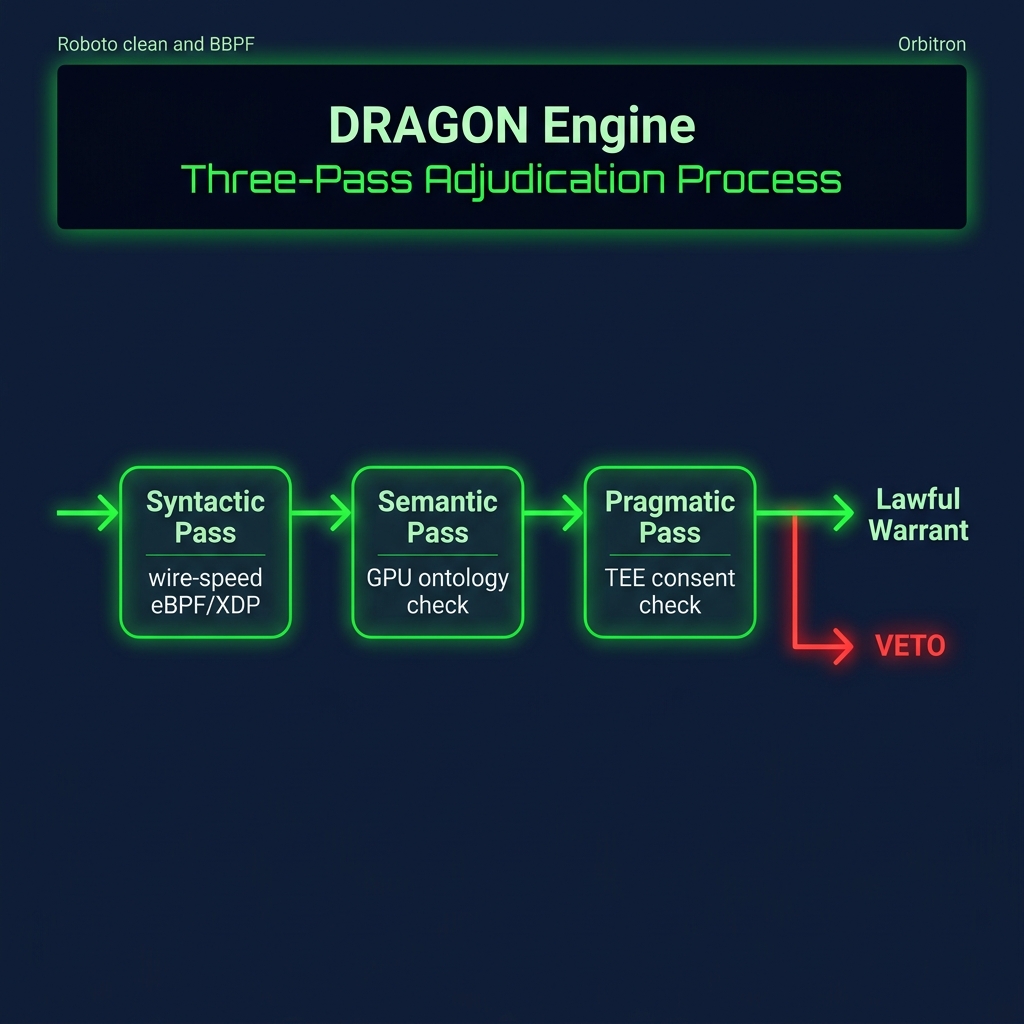
Adjudication flow: Syntactic Pass (wire-speed eBPF/XDP checking) → Semantic Pass (GPU ontology reasoning) → Pragmatic Pass (TEE jurisdiction and consent checks) leading to a Lawful Warrant or a Structural VETO.
Compliance Core Schemas
The core transaction payload block committed to the bitemporal ledger for system validation. This ledger serves as the Emotional Bedrock of Total Trust: by producing a mathematical proof of every transaction in real-time, it forms an Audit-as-a-Query ledger. If an incident or exception occurs, tenants run automated queries against the ledger to determine exactly which logic, hardware, or model state failed. This eliminates inter-tenant finger-pointing and supports Blameless Post-Mortems, since the cryptographic audit trail establishes objective truth instantly.
I. Lawful Act Hyperedge (LAHE) Wire-Trace Schema
{
  "laheId": "lahe-csma-2026-9921a",
  "policyHash": "PH-8f3a9b2c7e1d4f6a8b0c2d4e6f8a0b2c4d6e8f0a2b4c6d8e0f2a4b6c8d0e2f4a",
  "agreementDagId": "AGR-BIAN-COREPAYMENT-V4",
  "action": "ExecuteInterbankSettlement",
  "actorSVID": "spiffe://onepoi.online/pbc/agreement/settlement-engine-core-01",
  "validTime": "2026-06-15T19:35:12.123048000Z",
  "transactionTime": "2026-06-15T19:35:12.456182000Z",
  "evidenceEnvelopeRef": "mveb-77123-zkp-capsule",
  "teeAttestation": "eyJhbGciOiJSUzI1NiIsInR5cCI6IkpXVCIsImtpZCI6InRlcS1xdW90ZS1rZXkifQ...[Base64 Intel SGX / AMD SEV-SNP Enclave Quote Data]",
  "signature": "MEYCIQCc3WUhXWUp6ZThzKzVw...[Base64 Platform Runtime Core Signature Asset]",
  "laheType": "COMMIT",
  "correlationId": "corr-99821-bian-settlement-flow"
}
II. Minimum Viable Evidence Bundle (MVEB) Reference Attributes
The immutable verification components packaged for the Recomputation-as-a-Service (RaaS) engine to support zero-knowledge auditing:
Globally unique tracking identifier mapped using the ordered UUIDv7 standard.
The active 256-bit platform Policy Hash used to verify the transaction thread during triadic adjudication.
The canonicalised input data block, maintaining cryptographic hashes of application payloads with sensitive PII stripped.
An indexed array mapping the traversal path of the Agreement DAG, matching execution nodes directly to high-precision hardware timestamps.
Physical hardware memory addresses pointing to platform TPM v2.0 measurements and enclave cryptographic signatures.
A deterministic pseudorandom number generator (PRNG) seed used to verify probabilistic risk and scoring calculations.
The digital signature generated by the platform core key of the DRAGON Engine, certifying the absolute legitimacy of the proof capsule.
TRS-MS Capability Sets
The named capability products hosted within the Trust, Risk & Security Management layer of the onePOI.online Architecture.

Bedrock TRS
Cryptographic root-of-trust and high-assurance key management foundation for Trust, Risk & Security.

Inspector
Automated compliance auditing, SBOM configuration scanning, and secure regulatory observation interfaces.
Posture 360º
Platform-wide Integrated Posture Management, embedding deterministic Deontic logic constraints directly into physical computing hardware.
KeyMESH
Sovereign Cryptographic Router separating tenant secrets and private keys inside hardware-isolated enclaves.

oneCERT
Continuous hardware attestation and HBOM validation engine securing edge terminals and computing nodes.
Silicon Root-of-Trust for Fiduciary Execution & Value Settlement
Every commercial transaction, banking credential, or autonomous financial settlement fundamentally requires an uncompromised physical trust root. The Salient FinTech Innovation Set provides the non-negotiable trust engine for the TRS-MS bedrock. By executing payment tokenization, biometric verification, and ISO 20022 message signing inside hardware-isolated enclaves, it guarantees that tenant secrets and financial transaction flows remain immune to host operating system compromises, hypervisor escapes, or side-channel snooping.
Hardware Enclave Isolation (oneVault MESH)
Multi-tenant cryptographic keys and private payment credentials run strictly within TEE hardware enclaves with memory encryption keys rotated per transaction stanza.
Wire-Speed SmartNIC DPU Clearing
Network packets carrying financial payloads undergo cryptographic signature verification and eBPF membrane filtering directly on SmartNIC DPUs at wire speed before touching application memory.
Continuous Attestation (oneCERT)
Hardware Bill of Materials (HBOM) and firmware states are verified against cryptographic reference manifests, guaranteeing that all banking nodes maintain continuous Authority to Operate.
Commission a 5-Day Architectural Discovery Sprint
Accelerate your path to sovereign digital commerce. In five intensive working days, our principal systems architects map your enterprise operational perimeters directly against the Six-Fold Symphony of Systems architecture.
Complete audit of current touchpoints against SoE, SoA, SoO, SoR, SoI, and TRS-MS boundaries.
Translating legacy silo APIs into canonical semantic service domains and Agreement DAG schemas.
Token Gantry and TEE isolation sizing for zero-leakage payment and identity workflows.
Boardroom-ready blueprint with targeted milestones for the Q4 2026 / 2027 production target state.
*Fixed-price introductory engagement for qualified enterprise tenant cohorts. Deployed exclusively to your designated sovereign boundary.
You've Explored the Full Symphony
From the Constitutional Bridge of the SoE to the Financial-Grade Bedrock of TRS-MS – the Symphony of Systems is a single, coherent Constitutional Operating System. Every layer governs. Every act is lawful. Every audit is deterministic.